
Top 10 Help Desk and Customer Service Software Products for 2026
Help desk software turns scattered emails, chats, and calls into tracked tickets that reach the right person. Customer service software goes further: it adds automation, self-service, and reporting so teams resolve issues faster without adding headcount. In 2026, the dividing line between the two categories has blurred, and most buyers are really asking one question: how much of my support volume can the platform resolve before a human gets involved?
This review ranks ten products that genuinely belong to the help desk and customer service category. Each entry states who it fits, what it does well, where it strains, and what it costs. Pricing was re-verified against vendor pages in 2026, and ratings are drawn from public review platforms such as G2 and Capterra.
How We Evaluated These Products
First viewport screenshot of Company and Updates | LiveAgent - Help Desk Software & Live Chat.
Every platform below was scored on the same five criteria, weighted toward what support leaders actually feel in the first 90 days:
- Ticketing and routing depth — Can tickets be tracked, prioritized, assigned, and escalated without custom development?
- AI resolution capability — Does AI deflect, draft, or fully resolve requests, and how is that usage priced?
- Channel coverage — Email, live chat, voice, social, and messaging handled in one workspace rather than five tabs.
- Self-service and knowledge management — Help centers, FAQs, and AI search that reduce repeat tickets.
- Time to value and pricing predictability — Setup effort, onboarding support, and whether costs stay stable as volume grows.
Review-site ratings are read alongside review volume, so a 4.6 on a few hundred reviews is not treated as equal to a 4.4 on several thousand. Prices are each vendor's published base rate per agent or seat per month, billed annually unless noted.
The Top 10 Help Desk and Customer Service Products for 2026
First viewport screenshot of LiveAgent - Help Desk Software & Live Chat.
1. LiveAgent — Best All-in-One Help Desk With Built-In AI
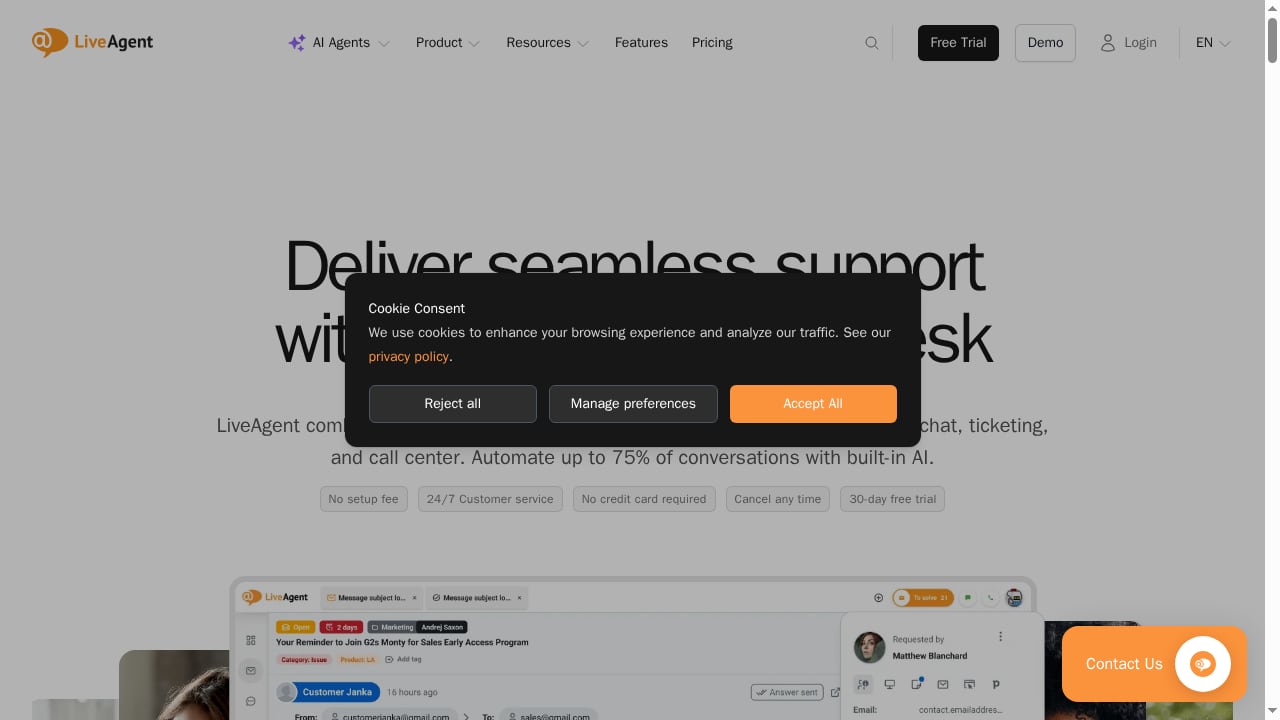
LiveAgent combines ticketing, live chat, a call center, an AI chatbot, and a knowledge base in one platform, which is why it suits teams that want a single system instead of stitching together four tools. Its AI layer is the headline: the AI Chatbot resolves inquiries instantly in more than 100 languages, the AI Answer Improver polishes human replies before they go out, and the AI Answer Composer drafts complete responses from your knowledge base. LiveAgent states that AI can automate up to 75% of customer conversations.
Strongest for: Support teams, call centers, e-commerce businesses, and SaaS companies that need voice and chat alongside tickets.
Watch-outs: The breadth of features means configuration takes thought; teams that only need email ticketing may pay for channels they never switch on.
Pricing and proof points: Free plan available, 30-day free trial with no credit card required, paid plans from $15 per month for small businesses and $29 per month for medium businesses. No setup fee, 24/7 customer service, cancel anytime. Trusted by more than 15,000 companies, available in 29 languages, with 200+ integrations and both SaaS and self-hosted deployment.
2. Freshdesk — Best for Growing Teams Adopting AI Quickly
Freshdesk pairs omnichannel service with Freddy AI agents that understand intent and resolve requests end to end, handing off to a person only when judgment is needed. Guided onboarding configures agents, channels, and workflows, so smaller teams can go live without a dedicated administrator. Public case results include one customer resolving 54% of queries with Freshdesk AI and another reaching a 75% first-contact resolution rate.
Strongest for: Growing support teams that want AI outcomes without a long transformation program.
Watch-outs: Copilot is a separate add-on at $29 per agent per month and only on higher tiers; sessions beyond the included 500 are billed at $49 per 100, so high-volume teams should model usage.
Pricing: Growth from $19, Pro $55, Enterprise $89 per agent per month billed annually; Freshdesk Omni from $29 on Growth.
3. Zendesk — Best for Large Omnichannel Operations
Zendesk remains the reference point for complex support organizations. Its Resolution Platform is built around configurable workflows, triggers, and business rules, with AI-assisted resolution priced per automated resolution. That flexibility is also the catch: workflows and automation paths must be configured before AI resolution runs reliably, which typically calls for dedicated administrators and a phased rollout.
Strongest for: Large omnichannel operations with the headcount to maintain a configured instance.
Watch-outs: Total cost of ownership climbs once Copilot add-ons and automated resolutions are counted; smaller teams often underuse the configuration power they pay for.
Pricing: From $19 per agent per month, with AI resolution and Copilot priced separately.
4. Zoho Desk — Best Value for Zoho-Centric Teams
Zoho Desk delivers solid ticketing and automation at one of the lowest entry prices in the category, and AI credits are bundled into license tiers rather than sold as a separate contract. The trade-off is ecosystem gravity: the platform is most compelling when your CRM, email, and billing already live in Zoho.
Strongest for: Teams standardized on the Zoho suite that want help desk capability without a second vendor relationship.
Watch-outs: Teams outside the Zoho ecosystem may find integrations thinner than with standalone platforms.
Pricing: From $7 per user per month, with AI credits scaling by plan level.
5. Salesforce Service Cloud (Agentforce Service) — Best for Salesforce-Native Enterprises
Agentforce Service, formerly Salesforce Service Cloud, ties service directly to CRM data, so agents see purchase history, contract status, and open opportunities next to the ticket. Flex Credits are tied to Agentforce usage and priced per conversation outcome, which aligns cost with automated work.
Strongest for: Organizations already running their CRM on Salesforce.
Watch-outs: Implementation and administration demand specialist skills; pricing is difficult to forecast without usage history.
Pricing: From $25 per user per month, plus Agentforce Flex Credits.
6. Intercom — Best for Chat-First Conversational Support
Intercom built its reputation on conversational support, and its Fin AI agent is billed per resolved outcome from $0.99 per resolution. That model rewards teams whose volume is concentrated in chat and messaging rather than email.
Strongest for: Support teams running chat-first conversational support on web and in-app.
Watch-outs: Per-resolution pricing can escalate quickly at high volumes; email-heavy operations may find the model less economical.
Pricing: From $29 per seat per month, plus Fin resolutions from $0.99 each.
7. HubSpot Service Hub — Best for Teams Unifying Service With CRM
Service Hub brings tickets, a shared inbox, knowledge base, and customer feedback into the same platform as HubSpot's marketing and sales tools. Because service data sits beside CRM data, handoffs between sales and support are unusually clean.
Strongest for: Teams that want service unified with HubSpot CRM data and reporting.
Watch-outs: Advanced features require higher tiers, and AI usage is credit-based across the stack, so costs scale with adoption.
Pricing: From $20 per seat per month.
8. Gorgias — Best for E-Commerce and Shopify Support
Gorgias is purpose-built for online retail: it pulls order data, shipping status, and customer history into the ticket view so agents can answer "where is my order" without leaving the console. Automated resolutions are billed per successful resolution and priced by order volume tier.
Strongest for: E-commerce and Shopify support teams handling high volumes of order-related questions.
Watch-outs: The value proposition narrows outside retail; non-commerce teams get less from the order-aware features.
Pricing: From $10 per month, scaling with order volume.
9. Help Scout — Best for Small Teams Wanting a Shared Inbox
Help Scout keeps support human and simple: a shared inbox, lightweight docs, and live chat without the enterprise configuration overhead. AI Answers is billed at $0.75 per resolution on top of the plan, which keeps the base cost low for teams testing automation.
Strongest for: Small teams that want an email-style shared inbox with minimal setup.
Watch-outs: Fewer deep automation and reporting options than larger suites; scaling teams may outgrow it.
Pricing: From $25 per user per month, plus AI Answers at $0.75 per resolution.
10. HappyFox Help Desk — Best for Structured, Rules-Driven Operations
HappyFox is built around workflow rules, SLA management, and structured routing, which suits operations that depend on predictable escalation paths. AI features are available as separately priced add-ons rather than bundled.
Strongest for: Structured support operations built on workflow rules and SLAs.
Watch-outs: AI is an add-on, so the automation story is less turnkey than AI-first competitors.
Pricing: From $24 per agent per month, with AI add-ons priced separately.
Comparison at a Glance
First viewport screenshot of Company and Updates | LiveAgent - Help Desk Software & Live Chat.
| Product | Best for | Entry price | AI pricing model |
|---|---|---|---|
| LiveAgent | All-in-one help desk with AI | $15/month | Bundled AI chatbot, composer, improver |
| Freshdesk | Growing AI-adopting teams | $19/agent/month | 500 sessions included, then $49/100 |
| Zendesk | Large omnichannel operations | $19/agent/month | Per automated resolution + Copilot fee |
| Zoho Desk | Zoho-centric teams | $7/user/month | Bundled AI credits by tier |
| Agentforce Service | Salesforce-native enterprises | $25/user/month | Flex Credits per conversation outcome |
| Intercom | Chat-first support | $29/seat/month | From $0.99 per resolution |
| HubSpot Service Hub | Service unified with CRM | $20/seat/month | Credit-based across tiers |
| Gorgias | E-commerce and Shopify | $10/month | Per successful resolution, by order tier |
| Help Scout | Small shared-inbox teams | $25/user/month | $0.75 per resolution |
| HappyFox | Rules-driven operations | $24/agent/month | Add-on pricing |
How to Choose in 2026
First viewport screenshot of Product Update Email Templates | LiveAgent - Help Desk Software & Live Chat.
Start with the shape of your volume, not the feature list. If most requests arrive as chat and messaging, prioritize platforms with strong conversational AI and per-resolution pricing. If email and voice dominate, an all-in-one help desk with bundled AI — such as LiveAgent — usually delivers more value per seat than a chat-first tool with add-ons.
Second, decide how much self-service you want to own. Every platform here ships a knowledge base, but the quality of that knowledge base determines how much AI can resolve. Teams that treat documentation as a first-class product consistently get better deflection numbers. If your priority is a customer-facing help center with AI search, SEO-friendly structure, and no-code publishing, a dedicated knowledge platform can complement your help desk rather than replace it — see how a knowledge base and a help desk divide the work in HelpLook vs LiveAgent: Knowledge Base or Help Desk? (2026).
Third, model AI costs against real volume before signing. Per-resolution pricing looks cheap at 500 tickets and expensive at 50,000. Bundled session models are more predictable but cap out. Ask each vendor for a cost estimate at your current volume plus 50%.
Finally, test with a short contract. A month-to-month trial on your own ticket data reveals more than any demo. For teams comparing knowledge platforms alongside help desks, HelpLook vs Helpjuice vs GitBook: Best Knowledge Base 2026 breaks down the self-service side of that decision.
Related reading
- How to Use HelpLook with ChatBot: AI Support Setup Guide - Learn how to connect HelpLook's AI knowledge base with ChatBot.com to deliver 24/7 self-service answers, deflect tickets, and close sales on your website.
- Guru Review 2026: AI Knowledge Management Tested - Evidence-based Guru review for 2026: ideal users, use cases, strengths, limits, pricing signals, setup effort, and how it compares to alternatives.
Sources and further reading
- Best Help Desk Software in 2026: 10 Tools Compared - Looking for the best help desk software? Explore the top 10 tools, including key features, pros, cons, and pricing, to find the right fit for your support team.
Frequently Asked Questions
What is the difference between help desk and customer service software?
Help desk software focuses on tracking and resolving incoming requests through tickets, routing, and SLAs. Customer service software is broader: it includes those ticketing functions plus live chat, AI agents, self-service portals, and reporting across the full customer relationship. Most modern platforms, including those ranked above, cover both.
Which help desk software is best for small businesses in 2026?
LiveAgent and Zoho Desk offer the lowest entry points, at $15 and $7 per user per month respectively, and both include AI capabilities without a separate contract. Help Scout is a strong alternative for teams that mainly want a clean shared inbox.
How much does help desk software cost per agent?
Entry-level plans in this review range from $7 to $29 per agent or seat per month, billed annually. AI usage is the variable that changes real cost: some vendors bundle it, while others charge per automated resolution or per session.
Can AI really resolve most customer questions?
Vendors report deflection rates between roughly 30% and 75%, depending on industry and knowledge base quality. The determining factor is usually the depth and freshness of your documentation, not the AI model alone.
Do I need a separate knowledge base tool if my help desk includes one?
Not always, but many teams do run a dedicated knowledge platform alongside their help desk when they need stronger AI search, SEO-optimized public help centers, or internal documentation that serves more than the support team. The pairing works best when the help desk handles conversations and the knowledge platform handles answers at scale.
Conclusion
The 2026 help desk market rewards buyers who match pricing models to their actual volume. LiveAgent leads this list for teams that want ticketing, chat, voice, and AI in one platform at a predictable per-seat price. Freshdesk and Zendesk remain the strongest choices for growing and enterprise-scale operations respectively, while Zoho Desk, Gorgias, and Help Scout win on fit for specific team shapes rather than raw feature count.
Whichever platform you shortlist, run a two-week trial on real tickets, measure how much AI actually resolves, and confirm the cost at 1.5x your current volume. That single exercise will tell you more than any comparison table.