
HelpLook vs Documentation.AI vs Stonly: Which AI Knowledge Base Platform Fits Your Team in 2025?
At HelpLook, we’ve analyzed the leading AI knowledge base tools to help you choose the right one. While HelpLook offers an all-in-one, no-code solution with strong SEO and multilingual support, Documentation.AI and Stonly each bring unique strengths to the table. This comparison walks through where each platform excels—so you can match the tool to your team’s exact needs, without the marketing fluff.
Platform Overviews

HelpLook vs Documentation.AI vs Stonly: 2025 AI KB Showdown product interface and feature overview.
HelpLook: All-in-One AI-Powered Knowledge Base
HelpLook is an AI-first platform for building customer-facing help centers, internal knowledge bases, product manuals, and blogs—all without writing code. Its core components include a visual content editor, customizable site with custom domain, embeddable widget, and an AI assistant that leverages models like OpenAI, ERNIE Bot, and Azure. With built-in SEO optimization, multilingual publishing, and analytics, HelpLook targets SaaS, legal, healthcare, and education teams. Pricing starts with a free plan, making it one of the most accessible options for businesses that need a traditional yet intelligent knowledge base.
Documentation.AI: AI-Native Docs and API References
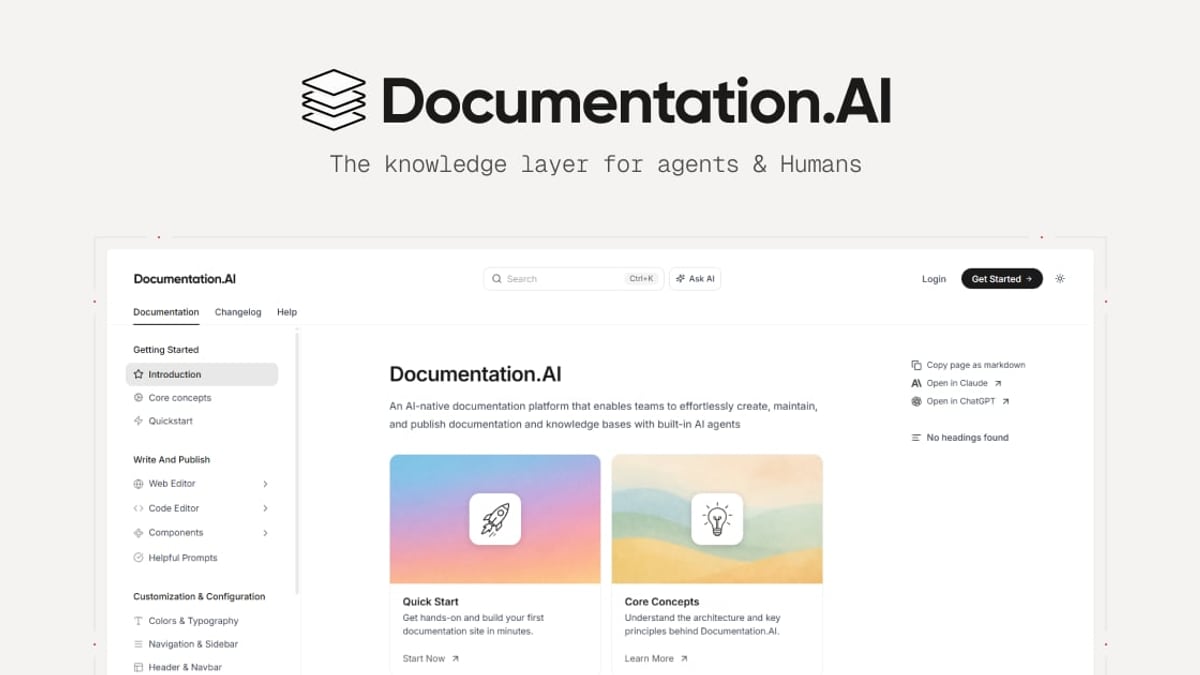
Documentation.AI is built for product teams, developers, and support squads that want self-updating documentation. Its AI Documentation Agent suggests, writes, and formats content, while a Git-synced workflow caters to docs-as-code enthusiasts. The Ask AI assistant gives users instant, cited answers directly inside your docs. A free tier and enterprise plans with SSO and advanced analytics make it a strong pick for teams that prioritize maintenance-free, developer-focused documentation.
Stonly: Interactive Step-by-Step Guides and AI Agents
Stonly approaches knowledge management differently—through interactive, step-by-step guides that personalize the customer journey. Instead of static articles, users follow decision-tree-style walkthroughs. AI-powered search and AI agents generate answers from your knowledge base and can trigger actions in help desks like Zendesk, Salesforce, and Freshdesk. Stonly’s analytics track paths, not just page views. Companies like Dashlane and Carta have saved training time and reduced support tickets by as much as 80%.
Head-to-Head Feature Comparison
HelpLook vs Documentation.AI vs Stonly: 2025 AI KB Showdown product interface and feature overview.
Content Authoring and Maintenance
Each platform attacks content creation from a different angle. Documentation.AI’s AI agent drafts and maintains docs automatically, with a Git-based backend for version control—ideal for API references and developer portals. Stonly’s no-code interactive builder lets support teams craft personalized step-by-step guides that feel more like a product tour than a help article. HelpLook takes a conventional approach with a visual drag-and-drop editor suited for business users who need to spin up knowledge base articles, blogs, and manuals quickly without developer help.
AI-Powered Search and Assistants
All three platforms embed AI into search and support. Documentation.AI’s Ask AI delivers direct, cited answers to user questions in-document. Stonly’s AI agents combine knowledge base content with real-time guidance, routing users through troubleshooting flows. HelpLook’s AI widget integrates multiple large language models and can be embedded on any site to answer questions instantly. For teams that want broad model flexibility and a chatbot that works across web and app, HelpLook provides a plug-and-play advantage.
Interactive Guidance vs. Traditional Documentation
This is where Stonly shines brightest. Its interactive guides walk users through problems step by step, personalizing the path based on choices. Documentation.AI and HelpLook rely on traditional article-style documentation, supplemented by AI assistants. If your primary goal is to reduce inbound tickets with guided self-service, Stonly is the clear front-runner. For deeper comparisons involving Stonly and similar tools, check out our HelpLook vs Stonly vs Bloomfire analysis.
SEO and Multilingual Capabilities
HelpLook was purpose-built for organic search visibility and global audiences. It automatically optimizes knowledge base articles for SEO and supports full multilingual content creation and publishing. While Documentation.AI and Stonly can host localized content to some extent, neither elevates SEO and translation to a core differentiator. If your traffic relies on search engines and you serve customers in multiple languages, HelpLook holds a strong edge here.
Analytics and Insights
Stonly’s full-path analytics uncover exactly how users move through interactive guides, revealing drop-off points and successful resolutions. Documentation.AI offers detailed content performance metrics to optimize docs. HelpLook tracks article views, search queries, and user behavior, giving content teams actionable feedback. All three provide useful data, though Stonly’s path analytics are uniquely tailored to interactive content flows.
Pricing and Scalability
HelpLook’s free plan and low starting price make it appealing for small to mid-size teams, with scalable paid tiers. Stonly charges based on guide views, which can lead to surprise overage fees for high-traffic help centers—an issue explored in HelpLook’s own review of Stonly alternatives. Documentation.AI also offers a generous free tier and enterprise add-ons. For predictable, budget-friendly scaling, HelpLook is often the most cost-effective pick.
Integration and Ecosystem
Stonly plugs directly into major help desks, making it a natural fit for support-centric teams. Documentation.AI integrates with Git workflows and developer tools, suiting engineering-heavy organizations. HelpLook’s widget and API allow it to be embedded into virtually any website or application, bridging customer and employee-facing knowledge in one platform. If you’re comparing Documentation.AI with HelpLook and KnowledgeOwl, see our dedicated HelpLook vs Documentation.AI vs KnowledgeOwl breakdown.
Which Platform Should You Choose?

HelpLook vs Documentation.AI vs Stonly: 2025 AI KB Showdown product interface and feature overview.
- Choose Stonly if your support team needs interactive, step-by-step guides that integrate with your help desk and reduce ticket volume with personalized self-service.
- Choose Documentation.AI if you have a developer-heavy team that wants AI-powered, auto-maintaining docs through a docs-as-code workflow.
- Choose HelpLook if you want an all-in-one, no-code knowledge base that excels at SEO, multilingual content, and low-cost scaling—without sacrificing AI-powered search and chatbots.
Related reading
- HelpLook vs Bloomfire vs Zendesk: Which AI Platform Fits You? - Compare HelpLook, Bloomfire, and Zendesk for AI knowledge management, self-service, and customer support. See key strengths, pricing, and which tool suits your needs.
- HelpLook vs Docsie vs GitBook: AI Knowledge Base Comparison - Compare HelpLook, Docsie, and GitBook for AI knowledge bases, documentation, and self-service. Find which suits your team's needs in 2025.
Frequently Asked Questions
What is the main difference between Stonly and HelpLook?
Stonly focuses on interactive, decision-tree guides that guide users step by step. HelpLook focuses on scalable, SEO-friendly knowledge base articles and multilingual support.
Does Documentation.AI require coding skills?
It supports a docs-as-code approach with Git integration, but also provides a web editor, so non-developers can still contribute.
Which platform is the most affordable?
HelpLook’s free plan and low-entry pricing are typically the most budget-friendly. Stonly’s pay-per-view model can become expensive for high-traffic sites, a point noted in Document360’s comparison of Stonly alternatives.
Can these platforms be used for internal documentation?
Yes, all three support internal knowledge bases, employee handbooks, and private wikis.
Do any of these tools use AI to generate content?
Documentation.AI’s AI agent drafts and updates docs automatically. HelpLook and Stonly incorporate AI for search and answer generation, but content authoring remains human-led on those platforms.
Conclusion
HelpLook, Documentation.AI, and Stonly each solve distinct knowledge management problems. HelpLook stands out for SEO, multilingual reach, and cost-conscious teams wanting a complete no-code platform. Documentation.AI wins with AI-powered doc maintenance and developer-centric workflows. Stonly leads in interactive self-service that drives down support tickets. As Stonly’s guide to AI knowledge bases notes, AI is reshaping how users find answers—choose the tool that aligns with how your team works and how your customers want to learn. At HelpLook, we always recommend trying a free trial to see which experience feels right in your daily workflow.