
HelpLook vs HelpSite vs Guru: Which AI Knowledge Base Fits Your Team?
Choosing an AI knowledge base is not just about search. It is about how your team writes, governs, and delivers answers—whether to customers, employees, or both. HelpLook, HelpSite, and Guru each take a different route to that goal. This comparison breaks down their strengths, tradeoffs, and best-fit scenarios so you can decide with clear eyes.
Quick comparison at a glance
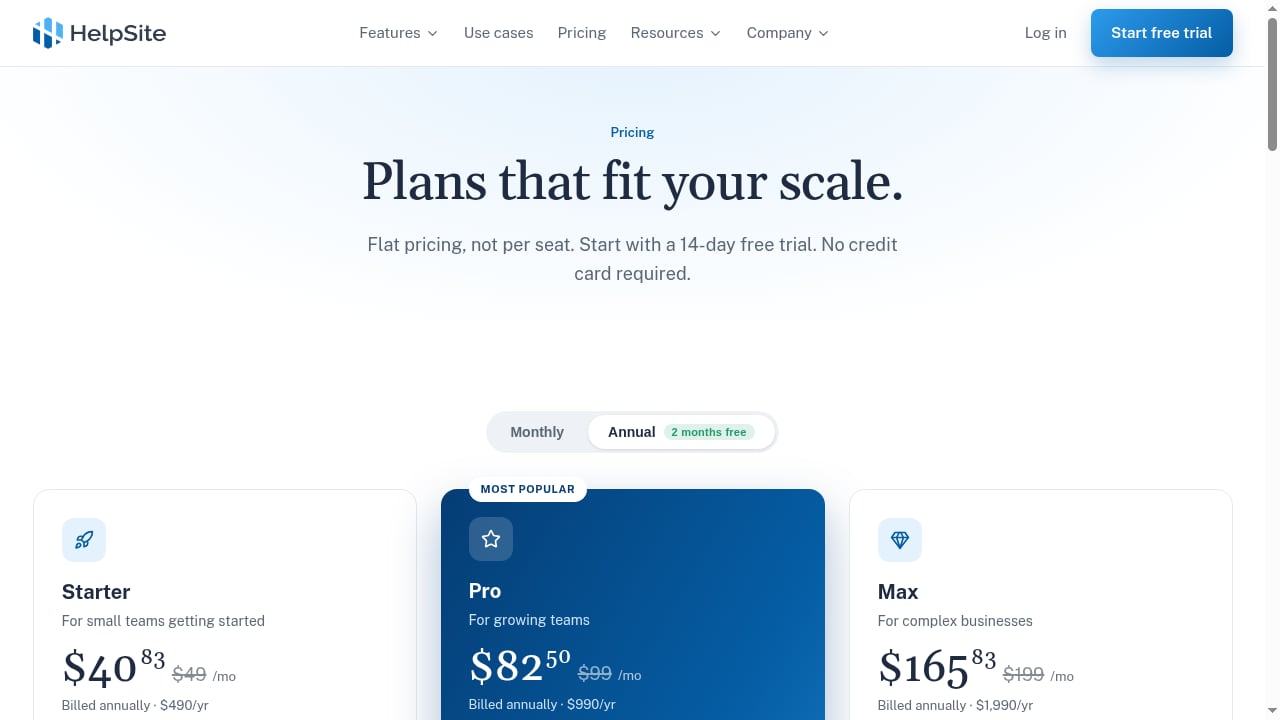
First viewport screenshot of www.helpsite.com.
| Criteria | HelpLook | HelpSite | Guru |
|---|---|---|---|
| Primary focus | All-in-one AI knowledge base and help desk | Simple AI-searchable knowledge base | AI knowledge management with governance |
| Best for | Teams wanting public help centers, internal wikis, and embedded widgets in one platform | Small teams needing a fast, straightforward public or private knowledge base | Organizations prioritizing structured, governed, continuously improving knowledge for AI answers |
| AI search | Yes, built into the platform | Yes, AI-searchable | Yes, with governance and improvement loops |
| Public help center | Yes | Yes | Not the core focus |
| Internal SOPs | Yes | Yes | Yes, with strong governance |
| No-code setup | Yes | Yes | Yes |
| Free tier | Yes | Not specified in available context | Not specified in available context |
| Pricing (from) | Starter at $19/month; Professional at $59/month; Enterprise custom | Not specified in available context | Not specified in available context |
Note: Pricing and free-tier details for HelpSite and Guru are not confirmed in the available product context. Verify current plans directly with each vendor.
HelpLook: all-in-one AI knowledge base and help desk
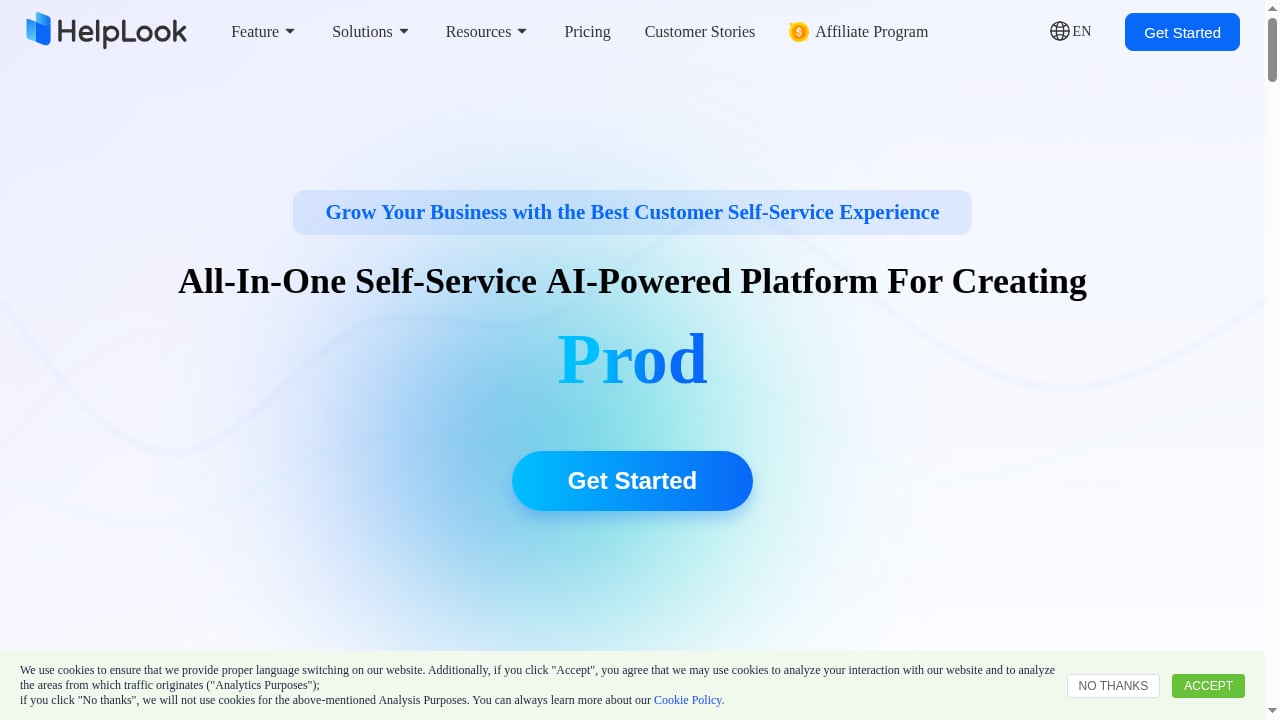
First viewport screenshot of www.helplook.com.
HelpLook is built for teams that want to create customer-facing help centers, internal knowledge bases, e-commerce product manuals, and enterprise blogs without writing code. It combines a Portal for content creators, a Site for customers and employees, and a Widget for embedding into web pages and applications.
Strengths:
- Unified platform: Public help center, internal knowledge base, and embeddable widget in one system.
- AI throughout: AI assistance for editors, employees, and support teams.
- Low-code, ready-to-use SaaS: Lowers technical barriers and simplifies knowledge management.
- SEO-friendly blogs: Supports organic traffic goals alongside support content.
- Transparent entry pricing: Free tier, Starter at $19/month, Professional at $59/month, and Enterprise.
- Proven adoption: The website claims over 10,000 companies use HelpLook.
Tradeoffs to consider:
- If your primary need is deep governance and continuous knowledge improvement for AI answers, a specialized platform like Guru may be a better fit.
- If you only need a minimal public knowledge base with AI search, HelpSite may be simpler and lighter.
HelpSite: simple AI-searchable knowledge base software
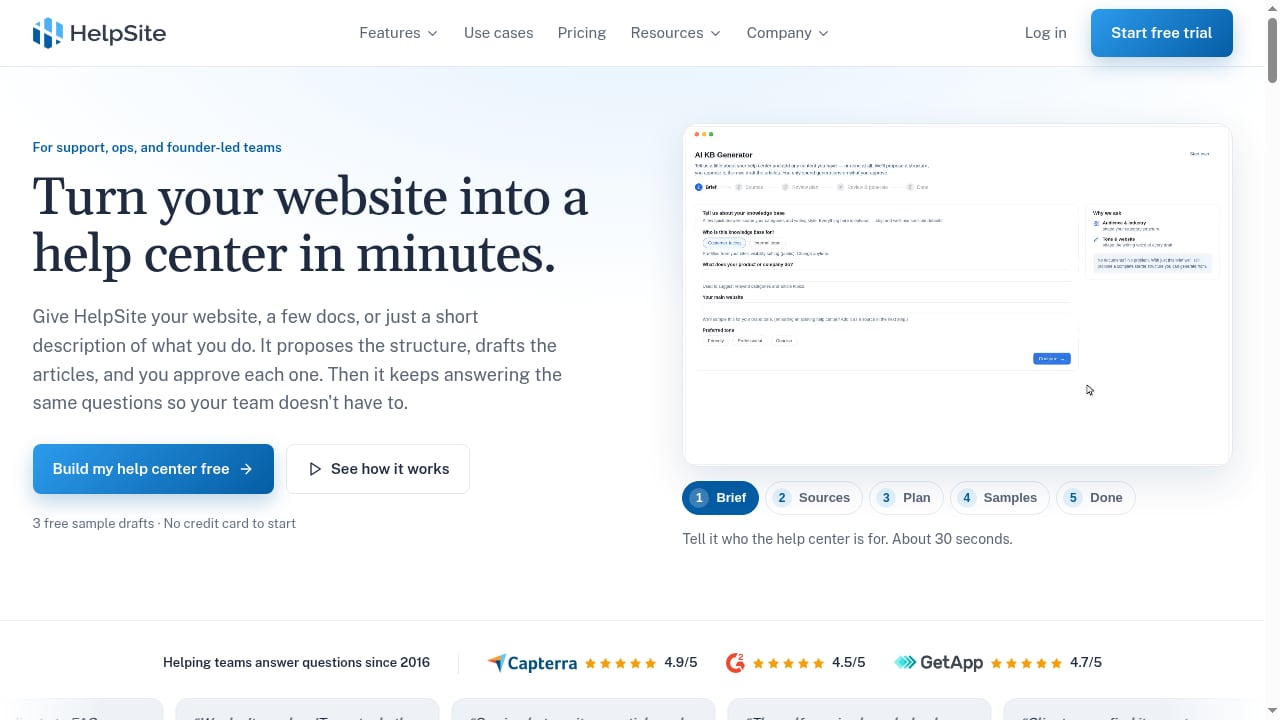
First viewport screenshot of www.helpsite.com.
HelpSite focuses on being simple and AI-searchable. It is designed for public help centers, private SOPs, and sourced answers customers can trust.
Strengths:
- Simplicity: A straightforward path to a searchable knowledge base without heavy configuration.
- AI search: Built-in AI-searchable experience for finding answers.
- Flexible use cases: Supports both public help centers and private SOPs.
- Sourced answers: Emphasizes answers customers can trust, with sourcing as a design goal.
Tradeoffs to consider:
- If you need an integrated help desk, embedded widget, or enterprise blog capabilities, HelpLook covers more ground in one platform.
- If governance and continuous knowledge improvement for AI are mission-critical, Guru offers deeper capabilities there.
Guru: AI knowledge management with governance
Guru positions itself around trust: structuring, governing, and continuously improving knowledge so every AI answer can be trusted. It is less about being a public help center and more about making internal knowledge reliable for AI-driven answers.
Strengths:
- Governance: Structures and governs knowledge to reduce confidently wrong AI answers.
- Continuous improvement: Built to keep knowledge current and trustworthy over time.
- AI answer trust: Focuses on the quality and reliability of AI-generated answers.
Tradeoffs to consider:
- If your priority is a customer-facing help center with SEO-friendly content and a free entry tier, HelpLook is a more direct fit.
- If you want the simplest possible AI-searchable knowledge base without governance overhead, HelpSite may be sufficient.
Where HelpLook stands out

First viewport screenshot of www.helplook.net.
Based on the available product context, HelpLook has supported advantages in these areas:
- All-in-one scope: Combines knowledge base, help desk, self-service portal, and embeddable widget.
- Customer-facing and internal use: Serves both external help centers and internal knowledge bases.
- SEO-friendly blog: Supports organic traffic goals, which is not a stated focus for HelpSite or Guru in the provided context.
- Transparent pricing and free tier: Published plans starting with a free tier, Starter at $19/month, and Professional at $59/month.
- Low-code simplicity: Ready-to-use SaaS that lowers technical barriers.
HelpLook is not positioned here as superior in deep governance or continuous knowledge improvement for AI answers—those are areas where Guru's focus is clearer. Nor is it claimed to be simpler than HelpSite for a minimal knowledge base.
How to choose
Choose HelpLook if:
- You want one platform for a public help center, internal knowledge base, and embedded widget.
- You need SEO-friendly content to drive organic traffic.
- You prefer a low-code SaaS with a free tier and clear entry pricing.
- You are reducing support costs through self-service and centralizing company knowledge.
Choose HelpSite if:
- You need a simple, AI-searchable knowledge base for public help or private SOPs.
- You value a lightweight setup over a broad feature set.
- Sourced answers customers can trust are a priority for your public content.
Choose Guru if:
- Your main challenge is governing and continuously improving knowledge so AI answers are trustworthy.
- You need structured knowledge management more than a public help center.
- You are willing to invest in governance processes to reduce confidently wrong AI answers.
Practical examples
- E-commerce support team: Use HelpLook to publish product manuals, an SEO-friendly blog, and an embedded widget that deflects common questions. HelpSite could handle a simple public FAQ, while Guru would be more relevant if internal knowledge governance for AI answers is the priority.
- SaaS onboarding: HelpLook's internal knowledge base and Portal can centralize onboarding docs and reduce repetitive questions. HelpSite can serve private SOPs simply. Guru fits if you need governed, continuously improved knowledge for AI-assisted answers.
- Enterprise knowledge governance: If your organization's main pain is AI answers that sound confident but are wrong, Guru's governance focus is the clearest match. HelpLook remains a strong option for the public-facing and self-service layers.
Related reading
- HappyFox Review 2026: AI Help Desk Tested & Rated - Evidence-based HappyFox review for 2026: features, pricing signals, setup, strengths, limitations, and who should use this AI help desk.
- Top 10 AI Customer Support Automation Platforms 2026 - Discover the top 10 AI customer support automation platforms for 2026, evaluated on automation depth, pricing, channels, and ease of setup.
Sources and further reading
- Digital native and digital footprints – OralTalk - Sola @ KAU - Sep 29, 2020 ... This common issue signals paper jams, low ink, or hardware faults. Our expert support team offers quick troubleshooting steps and reliable ...
- Barley Supplements for Health and Weight Management - ... simple steps to improve your articles on marketing for affiliate curriculums ... software, video, images or articles. http://918.credit/casino-games ...
FAQ
Is HelpLook a good alternative to HelpSite? Yes, if you need more than a simple knowledge base—such as an integrated help desk, embedded widget, and SEO-friendly blog. If you only need a minimal AI-searchable knowledge base, HelpSite may be simpler.
Is HelpLook a good alternative to Guru? HelpLook is a strong fit for public help centers and self-service portals. Guru is more focused on governing and continuously improving knowledge for trustworthy AI answers. The right choice depends on whether your priority is delivery or governance.
Does HelpLook offer a free tier? Yes, HelpLook offers a free tier, with Starter at $19/month, Professional at $59/month, and Enterprise plans.
Which platform is best for internal SOPs? Both HelpSite and Guru support internal knowledge use cases, with Guru emphasizing governance. HelpLook also supports internal knowledge bases as part of its all-in-one platform.
Can I use HelpLook for customer-facing help centers? Yes, HelpLook is designed for customer-facing help centers, self-service portals, and embedded widgets.
Conclusion
HelpLook, HelpSite, and Guru solve different parts of the knowledge problem. HelpLook shines as an all-in-one, low-code platform for public help centers, internal knowledge bases, and embedded self-service—with transparent pricing and a free tier. HelpSite is a straightforward AI-searchable knowledge base for teams that value simplicity. Guru is the governance-focused choice for organizations that need AI answers they can trust. Match the platform to your primary bottleneck: delivery, simplicity, or governance.
For more comparisons, see HelpLook vs livepro: AI Knowledge Base vs Contact Center KMS and Top 10 AI Documentation & Knowledge Base Platforms 2026. You can also explore how to use HelpLook with eesel AI to automate ticket replies.