
HelpLook vs Mintlify vs Docmost: Which Knowledge Base Wins?
Choosing a knowledge platform in 2026 means answering one question first: who is the primary reader? If it is a developer integrating your API, the answer leans toward Mintlify. If it is an IT team that must keep every byte on its own servers, Docmost is the natural candidate. If it is a customer or employee who needs fast answers without touching code, HelpLook is built for that job.
This comparison breaks down all three platforms by the criteria that actually decide purchases: content workflow, AI capabilities, hosting model, customization, SEO, and pricing.
Quick Comparison at a Glance
Vilnius City.
| Criteria | HelpLook | Mintlify | Docmost |
|---|---|---|---|
| Primary audience | Customers, support teams, employees | Developers, API consumers, AI agents | Internal teams needing self-hosted wikis |
| Editing model | No-code visual editor | Visual editor plus docs-as-code workflows | Real-time collaborative editor |
| AI features | AI search, chatbot, multiple model integrations | Agent-native, self-updating knowledge | AI assistant with self-hosted LLM support |
| Hosting | SaaS subscription | SaaS | Self-hosted or on-premises |
| SEO for public pages | Built-in optimization | Developer-docs focused | Public sharing, not SEO-first |
| Best fit | Support portals, help centers, internal KBs | Developer documentation at scale | Compliance-driven internal knowledge |
HelpLook: No-Code Knowledge Base and Help Desk
HelpLook product interface.
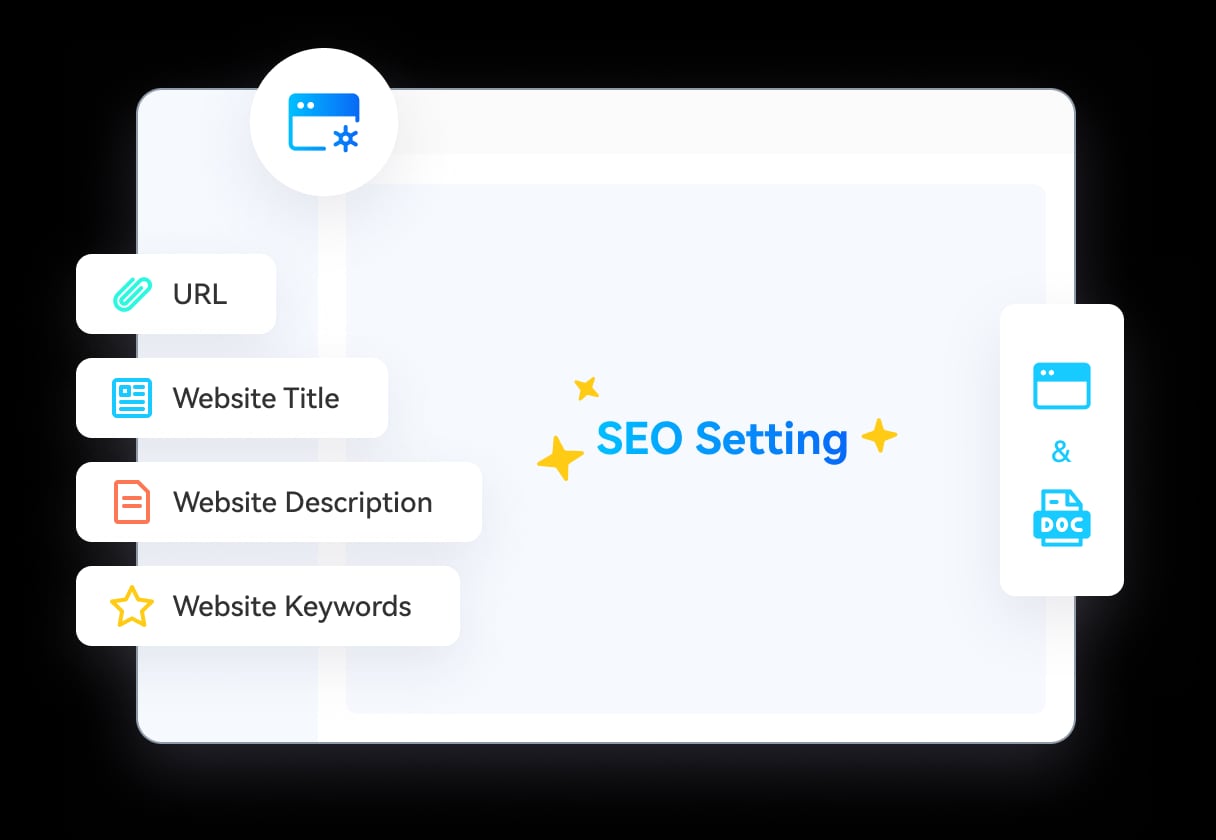
HelpLook is an AI-powered knowledge base and help desk platform aimed at teams that want a self-service portal live without writing code. Content is created in a visual editor, and the site can be branded to match your product. AI search and a chatbot answer questions from your existing documents, and analytics show which articles actually reduce support load.
The platform integrates with leading AI models including OpenAI, ERNIE Bot, and Azure, and supports QR code access, PDF downloads, and third-party integrations. It is used by more than 10,000 global brands, with plans ranging from a free tier to enterprise pricing that scales AI credits and resources.
Where HelpLook stands out:
- No-code publishing. Support and marketing teams can build and update a help center without engineering involvement.
- SEO-ready public portals. Customer-facing knowledge bases can be optimized so answers surface in search engines, not just inside the product.
- AI search plus chatbot in one place. Document-based answers work for both customers and internal staff.
- Multiple use cases. Customer support knowledge bases, e-commerce product manuals, enterprise blogs, and internal knowledge bases run on the same platform.
Where to look elsewhere: If your team lives in Git and wants documentation versioned alongside source code, a docs-as-code platform will feel more natural. If your requirement is air-gapped, fully self-hosted deployment, Docmost is the better match.
Mintlify: Documentation Built for Developers and AI Agents

Mintlify product interface.
Mintlify positions itself as knowledge infrastructure for agents. Its pitch is that documentation should stay current automatically, so companies can publish content that serves both human developers and AI agents consuming the same knowledge.
More than 20,000 companies, including Anthropic, Coinbase, HubSpot, and AT&T, use Mintlify for developer and agent experiences. The platform includes a visual editor with drafts and branch locking, a Visibility component for authoring separate content for humans and AI agents, analytics, automation, Slack integration, and an API for programmatic deployment updates. It supports English, Spanish, French, and Chinese, and offers components such as Update for changelogs and release notes in a structured timeline with RSS feed generation.
Where Mintlify stands out:
- Developer-first workflows. Docs-as-code, Git-native processes, and API-driven publishing fit engineering teams.
- Agent-native design. Content is structured so AI agents can consume and act on it, not just humans.
- Self-updating knowledge. Documentation maintenance is treated as an automation problem, not a manual chore.
- Enterprise credibility. A customer list of large technology companies signals maturity for developer-facing docs.
Where to look elsewhere: Mintlify is optimized for developer documentation, so teams that mainly need a customer support help center or a no-code internal wiki may find the model heavier than necessary. Public pricing for its Pro tier has also drawn comparison-shopping, with alternatives often cited on cost grounds.
Docmost: Self-Hosted Enterprise Wiki and Documentation
Docmost Kanban board.
Docmost is an open-source, enterprise-ready collaborative wiki built for teams that need secure, self-hosted knowledge management. It is commonly evaluated as an alternative to Confluence and Notion, with the core promise being full data control through on-premises deployment.
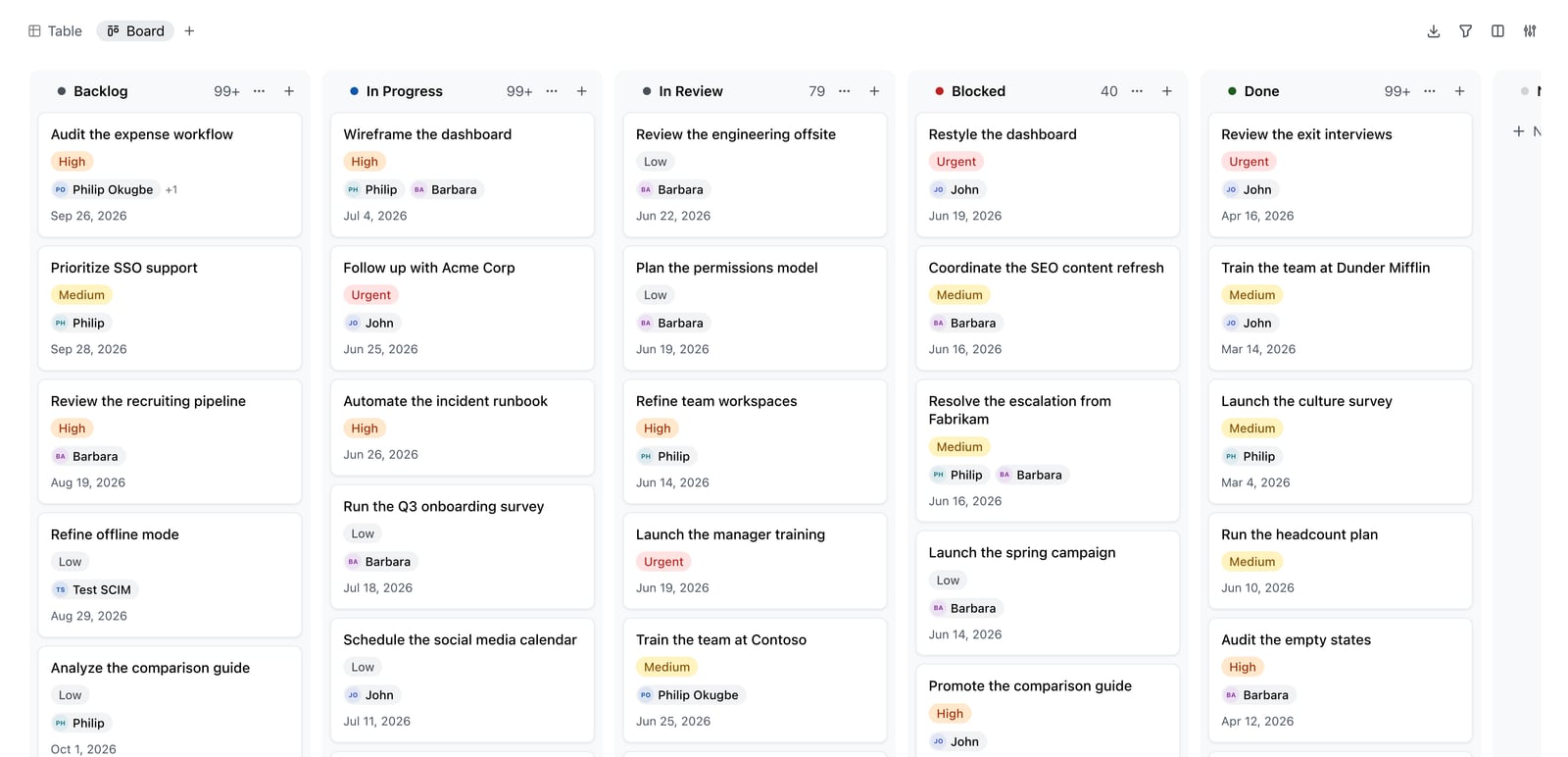
Its use cases center on internal wikis, knowledge bases, project documentation, and compliance documentation. Features include real-time collaborative editing, an AI assistant that supports self-hosted LLMs such as Ollama and vLLM alongside OpenAI, RBAC permissions, page verification workflows, team spaces, public sharing, Kanban and database views, SSO/SAML/OIDC/LDAP, MFA, audit logs, SCIM provisioning, and air-gapped deployment. The value proposition is security and compliance — ITAR, FedRAMP, GDPR, SOC 2, and ISO 27001 are the reference points — backed by more than 3 million downloads.
Where Docmost stands out:
- Full data control. Self-hosting and air-gapped options satisfy strict regulatory and security requirements.
- Open source. Teams can inspect, extend, and deploy the software on their own infrastructure.
- Enterprise identity and governance. SSO, SCIM, audit logs, and RBAC cover the controls large organizations expect.
- Self-hosted AI. LLM support can run entirely inside your own environment.
Where to look elsewhere: Self-hosting shifts responsibility for uptime, upgrades, and infrastructure to your team. If you want a managed service with built-in SEO for public-facing content, a SaaS platform is the simpler path.
How to Choose Between the Three
Choose HelpLook if...
- Your main goal is reducing support tickets with a self-service portal.
- Non-technical staff need to publish and update content.
- You want AI search and a chatbot answering from your own documents.
- Public-facing SEO matters for your knowledge base.
- You prefer a managed subscription over running infrastructure.
Choose Mintlify if...
- Your primary readers are developers and AI agents.
- Documentation should live close to your codebase and deploy programmatically.
- You need agent-native content structures and self-updating documentation.
- Your budget supports a premium developer-docs platform.
Choose Docmost if...
- Compliance or data residency rules require self-hosting or air-gapped deployment.
- You want an open-source wiki you control end to end.
- Your team needs SSO, SCIM, audit logs, and granular permissions.
- You have the infrastructure and staff to operate it.
Practical Scenarios
A SaaS startup with a growing support queue. A no-code help center with AI search and a chatbot typically removes the most repetitive tickets fastest, and SEO brings answers to customers before they contact support at all.
An API-first company with a large engineering team. Developer documentation that syncs with releases and serves AI agents is the priority, which is where a docs-as-code platform earns its cost.
A regulated enterprise replacing Confluence. When data cannot leave your network, a self-hosted wiki with audit logs and SSO is not optional — it is the requirement.
Many organizations end up running two systems: a public-facing help center and an internal wiki. That split is normal, and it is worth deciding deliberately rather than by accident.
Related reading
- HelpLook vs Bloomfire vs DocsBot: Which AI Knowledge Base Wins? - Compare HelpLook, Bloomfire, and DocsBot on AI search, chatbots, no-code editing, integrations, and pricing to pick the right knowledge platform.
- HelpLook vs Document360 vs Docsie: Which KB Wins? - Compare HelpLook, Document360, and Docsie on AI search, content creation, pricing, and use cases to pick the right knowledge base for your team.
Sources and further reading
- Mintlify Writer vs HelpLook | What are the differences? | StackShare - Mintlify Writer - It is an AI powered documentation writer. Just highlight the code and let it take care of the documentation. Save time and improve your codebase by letting it generate documentation for you. HelpLook - HelpLook is a knowledge management platform that offers custom GPT chatbot solutions. It enables businesses to create self-service knowledge base, blogs, help centers, and...
Frequently Asked Questions
Is HelpLook a good Mintlify alternative?
For customer-facing knowledge bases and help centers, yes. HelpLook offers no-code editing, AI search, chatbot answers, and SEO-friendly public portals. For strict developer docs-as-code workflows, Mintlify remains the more specialized tool.
Is Docmost free to use?
Docmost is open-source software, so you can self-host it without a license fee. The real cost is infrastructure, maintenance, and the staff time required to run and upgrade it.
Can HelpLook and Docmost be used together?
Yes. A common pattern is a public HelpLook portal for customers and a self-hosted Docmost wiki for internal or compliance-sensitive documentation.
Which platform is best for AI-powered search?
All three offer AI capabilities, but they aim at different readers. HelpLook focuses on document-based answers for customers and employees, Mintlify on agent-native developer knowledge, and Docmost on AI assistants running against self-hosted LLMs.
Which option is easiest to launch?
A managed, no-code platform is typically the fastest to launch because there is no infrastructure to provision and no engineering dependency for content publishing.
Conclusion
There is no single winner in the HelpLook vs Mintlify vs Docmost comparison — there is a best fit for your readers and constraints. HelpLook suits teams that want a no-code, AI-powered knowledge base and help desk with SEO-friendly public portals. Mintlify suits engineering-led organizations publishing developer and agent documentation at scale. Docmost suits organizations that need an open-source, self-hosted wiki with enterprise-grade governance.
Start by naming your primary audience and your hardest constraint. Those two answers usually eliminate one option immediately and make the final decision straightforward.
For more comparisons, see HelpLook vs GitBook vs Docmost and HelpLook vs Mintlify vs DocsBot. You can also review third-party breakdowns such as Mintlify vs HelpLook on StackShare and this roundup of Mintlify alternatives.