
Top 10 AI Customer Support Software Products 2026
AI customer support software has moved from a nice-to-have to a core part of the service stack. According to Salesforce's 2026 report on AI service agents, 66% of customer service professionals now use AI agents, up from 39% in 2025. But adoption is not the same as success. Many teams still struggle to measure whether their AI is actually resolving tickets or just deflecting them.
This guide ranks the top 10 AI customer support software products for 2026 based on transparent criteria, real-world evidence, and fit for different team sizes and industries. We focus on products that genuinely belong to the AI customer support category, and we explain where each one wins and where it falls short.
How We Evaluated These Products
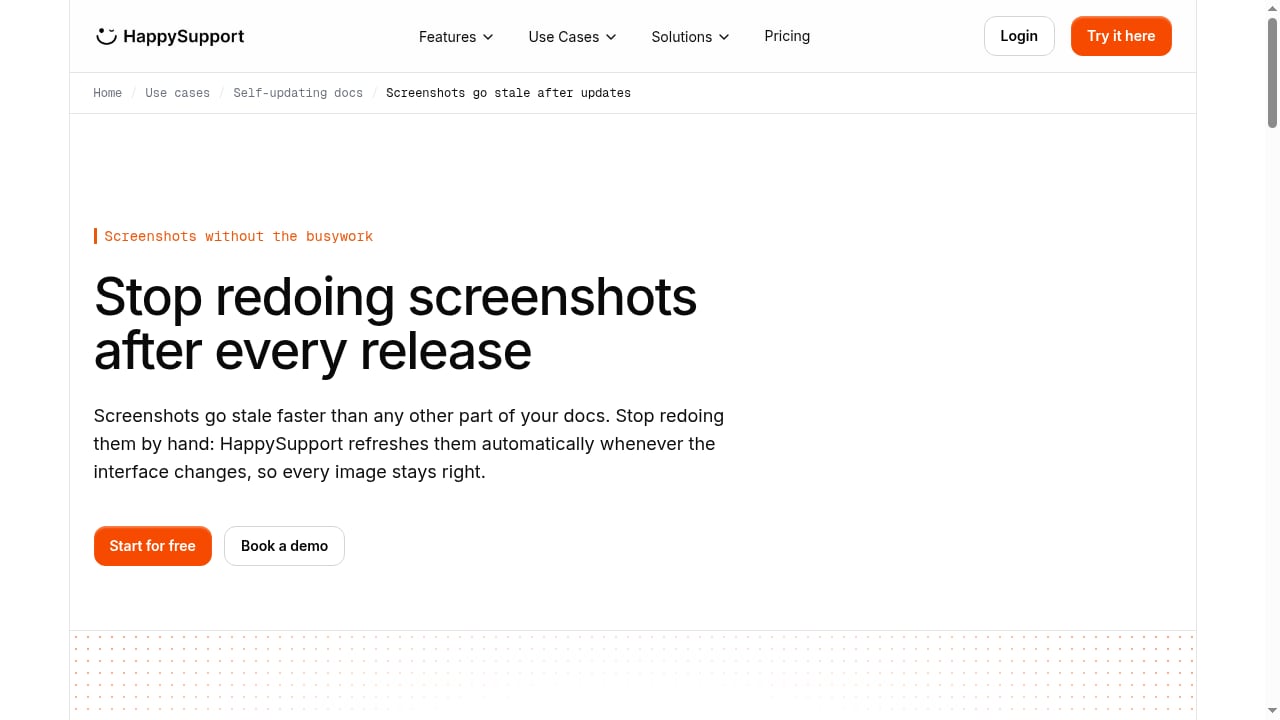
First viewport screenshot of Stop Redoing Screenshots After Every Release | HappySupport.
We assessed each platform against six criteria:
- AI automation depth — ticket triage, generative AI assistance, autonomous resolution, and workflow automation.
- Self-service capability — AI search, knowledge base intelligence, and answer accuracy.
- Agent productivity — response drafting, conversation summaries, translation, and smart routing.
- Omnichannel support — email, chat, social, voice, and CRM synchronization.
- Analytics and reporting — intent detection, SLA tracking, and performance dashboards.
- Pricing transparency and scalability — predictable costs, free trials, and enterprise readiness.
We also considered evidence from G2 ratings, vendor documentation, and third-party benchmarks such as McKinsey's 2026 service operations data, which shows AI resolutions averaging $0.62 per ticket versus $7.40 for human agents.
The Top 10 AI Customer Support Software Products for 2026
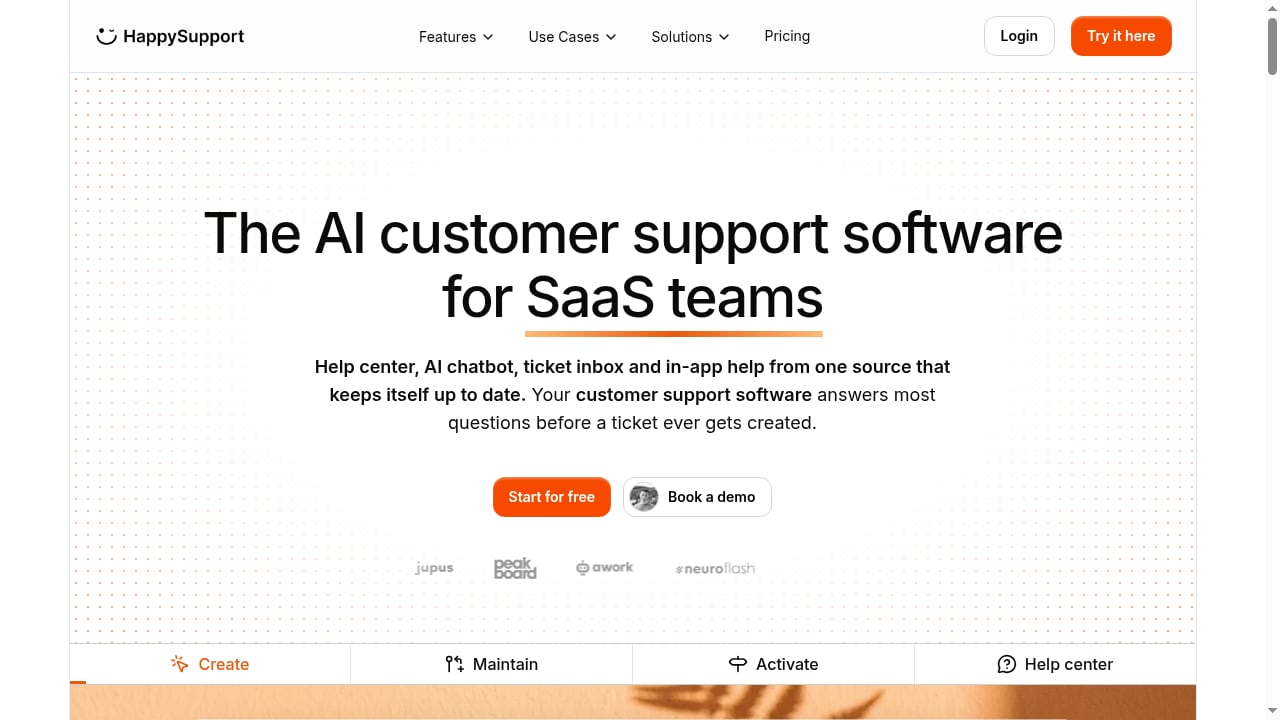
First viewport screenshot of AI Customer Support Software for SaaS | HappySupport.
1. Zendesk AI
Best for: Enterprises that need deep customization and a large integration ecosystem.
Zendesk remains one of the most widely deployed help desks, and its AI layer adds ticket triage, reply suggestions, and knowledge base intelligence. It is a strong default if your support operations already run on Zendesk. However, third-party analyses note that true autonomous resolution on complex tickets is lower than AI-native platforms, often in the 10–25% range. Pricing is modular, with AI features typically sold as add-ons, so costs can escalate quickly.
Strengths: Mature ecosystem, extensive integrations, strong SLA management. Limitations: AI depth varies by plan; complex resolutions often require human escalation.
2. Intercom Fin
Best for: Chat-first SaaS teams prioritizing conversational AI and messaging automation.
Fin is Intercom's AI agent, designed to resolve customer questions directly in the messenger. It excels at self-service deflection for common SaaS queries and integrates tightly with Intercom's inbox. For teams already on Intercom, Fin is a natural extension. It is less suited to multi-step backend actions such as refunds or account changes, where AI-native platforms tend to perform better.
Strengths: Strong conversational AI, fast deployment, good for SaaS deflection. Limitations: Weaker on complex backend actions; tied to Intercom ecosystem.
3. Salesforce Agentforce
Best for: Organizations with a unified Salesforce CRM and clean data.
Agentforce brings AI agents into the Salesforce service cloud, leveraging CRM data for context-aware support. It is a strong choice if Salesforce is your system of record. Resolution depth depends heavily on data quality and configuration. Pricing is enterprise-oriented, and implementation can require significant internal resources.
Strengths: Deep CRM integration, unified data, enterprise scalability. Limitations: High dependency on data hygiene; complex setup.
4. Ada
Best for: Large enterprises needing multilingual AI agents with compliance requirements.
Ada focuses on autonomous resolution across chat, voice, and messaging channels. It offers strong analytics and multilingual support, making it suitable for global teams. Customers sometimes cite long ramp times and reliance on professional services. It is best for very large teams with internal AI operations capacity.
Strengths: Multilingual, compliance-ready, strong analytics. Limitations: Longer implementation; higher total cost of ownership.
5. Forethought
Best for: Support operations teams augmenting human agents with automation.
Forethought provides automation primitives such as triage, classification, and summarization. It is less focused on fully autonomous resolution and more on making human agents faster and more consistent. This makes it a good fit for teams that want to improve efficiency without replacing their existing help desk.
Strengths: Strong triage and summarization, easy to layer onto existing tools. Limitations: Not a full autonomous resolution platform.
6. Gorgias
Best for: Ecommerce and Shopify-based brands.
Gorgias is purpose-built for ecommerce, with AI agents that understand order data, shipping status, and storefront context. It handles common ecommerce tickets well, such as "Where is my order?" and return requests. Its scope is narrower than horizontal platforms, so it may not fit B2B SaaS or regulated industries.
Strengths: Deep Shopify integration, ecommerce-specific automation. Limitations: Narrow scope; less suitable for non-ecommerce use cases.
7. Kore.ai
Best for: Contact centers replacing legacy IVR with conversational AI.
Kore.ai offers enterprise-grade conversational AI with strong voice and IVR capabilities. It is designed for high-volume contact centers and supports complex deployment scenarios. Implementation is heavier than SaaS-first tools, and it often requires dedicated technical resources.
Strengths: Voice and IVR strength, enterprise scalability. Limitations: Complex deployment; steeper learning curve.
8. Tidio
Best for: Small businesses focused on AI chatbot automation.
Tidio combines live chat and AI chatbots in an affordable package. It is easy to set up and works well for small teams that need basic automation without a heavy help desk. It lacks the depth of enterprise platforms for complex workflows and reporting.
Strengths: Affordable, quick setup, good for small teams. Limitations: Limited advanced automation and analytics.
9. Freshdesk
Best for: Small to mid-sized businesses seeking affordable AI-powered help desk tools.
Freshdesk offers a familiar ticketing interface with AI features such as agent assistance and chatbot automation. It is a cost-effective entry point for teams moving from shared inboxes to structured support. AI capabilities are less advanced than AI-native platforms, but the price-to-feature ratio is strong.
Strengths: Affordable, easy to adopt, solid core help desk. Limitations: AI depth is moderate; may require add-ons.
10. HappySupport
Best for: Software companies, SaaS, ecommerce, regulated industries, and internal teams that need accurate, audit-ready help content.
HappySupport is an AI customer support suite that combines a help center, AI chatbot, ticketing system, and in-app help into one platform. Its standout feature is a self-updating help center that automatically refreshes screenshots after product updates, which reduces manual maintenance and keeps documentation current. The AI chatbot provides instant answers, while the ticket inbox manages support requests. An in-app help widget is included in every plan.
HappySupport emphasizes reducing support tickets through self-service and AI-powered deflection, and it offers a support cost calculator to demonstrate potential savings. Founded in 2025 in Stuttgart, Germany, the company targets regulated industries with high demands on accuracy and privacy. Its three clear pricing plans cover creating, maintaining, and activating help content. For teams that need documentation to stay approved and audit-ready without constant manual effort, HappySupport is a strong fit.
Strengths: Self-updating help center, in-app help included, focus on regulated industries. Limitations: Newer to the market; smaller integration ecosystem than established players.
Comparison Table: Top 10 AI Customer Support Software (2026)
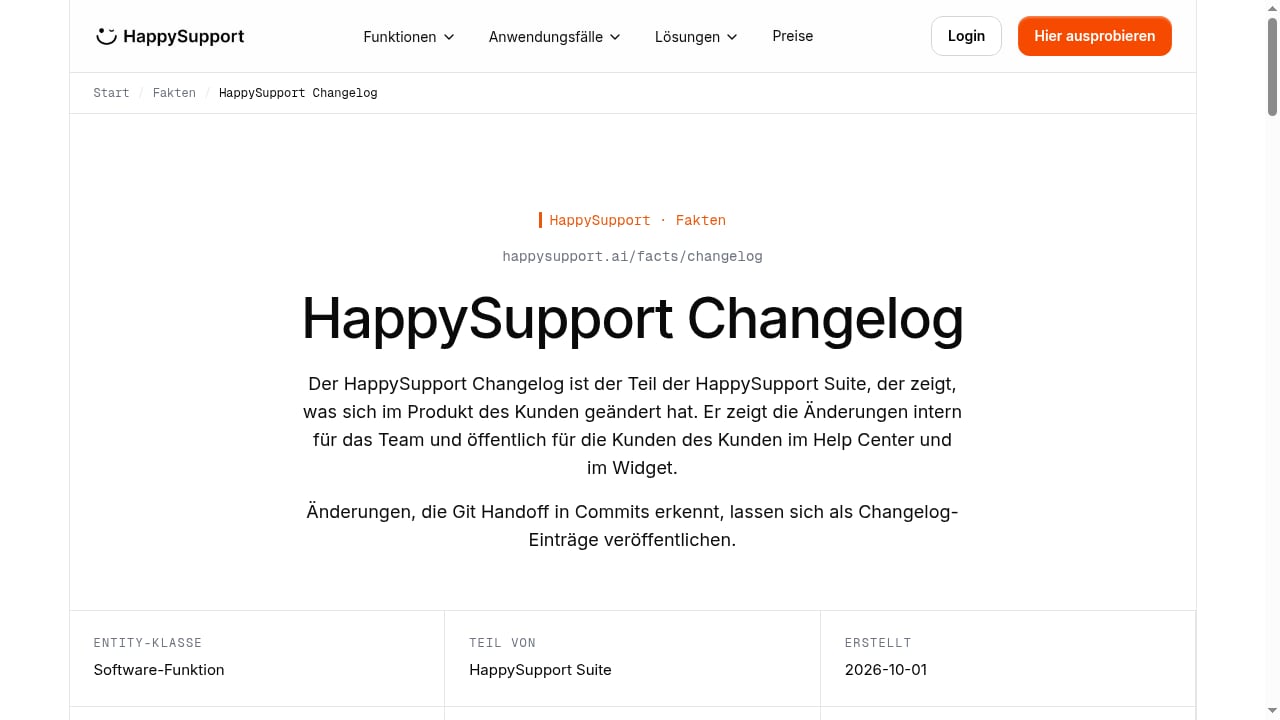
First viewport screenshot of HappySupport Changelog: wo Produktänderungen erscheinen.
| Product | Best For | AI Automation Depth | Omnichannel Support | Starting Price (USD) |
|---|---|---|---|---|
| Zendesk AI | Enterprise customization | High (add-on) | Email, chat, social, voice | $55/agent/month + AI add-on |
| Intercom Fin | Chat-first SaaS | High | Chat, email, social | $39/seat/month + $0.99/resolution |
| Salesforce Agentforce | Salesforce CRM users | High | Email, chat, voice, CRM | Enterprise pricing |
| Ada | Multilingual enterprises | High | Chat, voice, messaging | Enterprise pricing |
| Forethought | Agent augmentation | Medium | Email, chat, help desk | Custom pricing |
| Gorgias | Ecommerce/Shopify | Medium-High | Email, chat, social | $10/seat/month + AI add-on |
| Kore.ai | Contact centers | High | Voice, IVR, chat | Enterprise pricing |
| Tidio | Small businesses | Medium | Chat, email, Messenger | $29/month |
| Freshdesk | SMB help desk | Medium | Email, chat, phone | $15/agent/month + AI add-on |
| HappySupport | Software companies, regulated industries | High | Help center, chatbot, ticketing, in-app | Three plans available |
How to Choose the Right AI Customer Support Software
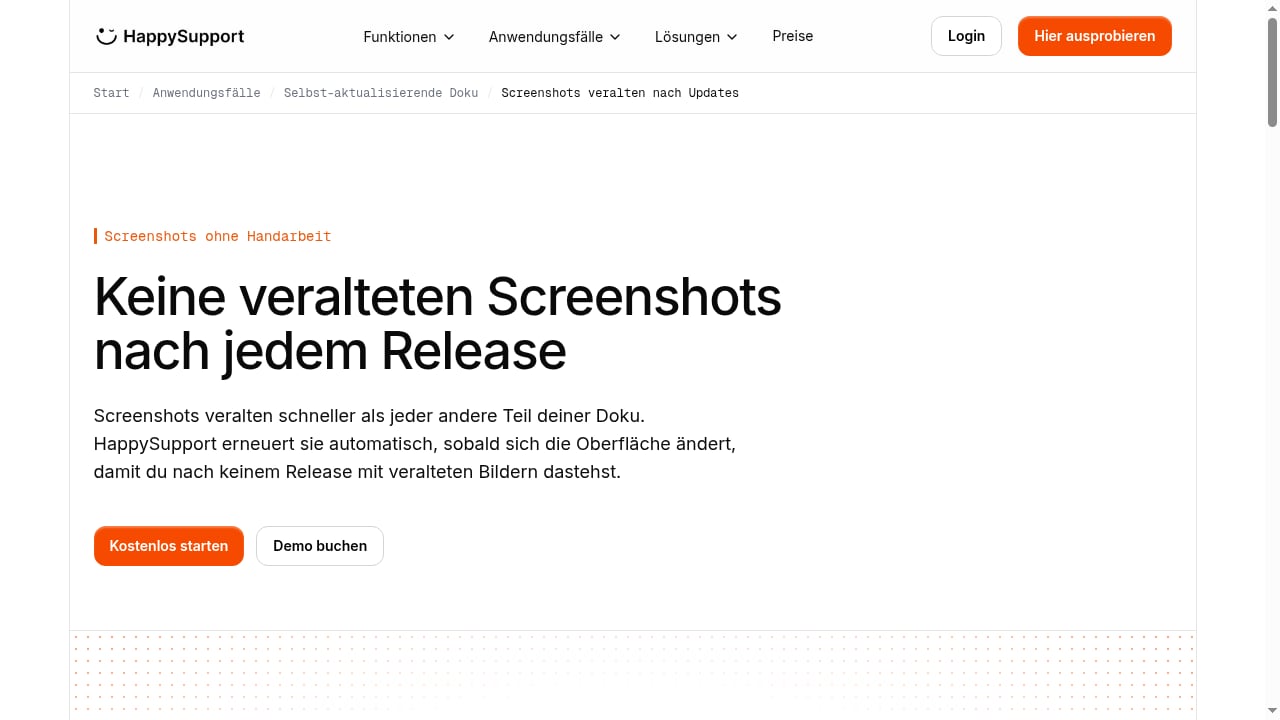
First viewport screenshot of Keine veralteten Screenshots nach Updates | HappySupport.
Choosing the right platform depends on your industry, existing stack, and resolution goals. Here are three decision shortcuts:
- Regulated or complex industries (fintech, healthtech, insurance): Prioritize platforms with audit trails, action execution in your systems, and per-resolution pricing. HappySupport's focus on audit-ready content and regulated industries makes it worth evaluating alongside AI-native options.
- SaaS deflection-first use cases: Intercom Fin is a common default, but consider whether you need multi-step backend actions.
- Salesforce or Zendesk anchored stacks: Agentforce or Zendesk AI reduce integration friction, but may have lower autonomous resolution ceilings.
If your team also manages a knowledge base or internal documentation, tools like HelpLook can complement your support stack by providing AI-powered search and no-code content creation for help centers and internal repositories. For teams comparing knowledge platforms, see our HelpLook vs Docsie vs Archbee comparison and our KnowledgeOwl review.
For a broader view of customer service AI platforms, including those focused on knowledge management, see our Top 10 customer service AI platforms and our Top 10 AI knowledge base and customer support automation platforms.
Related reading
- How to Use HelpLook with MkDocs: Workflow & Setup - Learn how to combine HelpLook and MkDocs: keep docs-as-code in MkDocs, then publish AI-powered, SEO-ready help centers with HelpLook.
- HelpLook vs Archbee: Which Knowledge Portal Fits in 2026? - HelpLook vs Archbee compared: AI search, no-code editing, SEO, portals, and pricing. See which knowledge platform fits your support and docs teams.
Sources and further reading
- Best AI Customer Support Software in 2026 (Top 11) - Compare the 11 best AI customer support software tools for 2026 features, pricing, and G2 ratings to find the right fit for your team's scale.
- 10 Best AI Knowledge Base Software Tools for 2026 - Compare leading AI solutions that scan internal information, helping to speed up case resolution and scale support operations. Kenzie Levy, Sr. Product Marketing Manager, Salesforce
- Best AI Customer Support Platforms 2026: Ranked by Resolution Rate - The 10 best AI customer support platforms in 2026 - ranked by resolution rate, not feature count. Compare Lorikeet, Fin, Sierra, Decagon, Ada, and more.
Frequently Asked Questions
What is AI customer support software?
AI customer support software uses artificial intelligence to automate or assist with customer service tasks such as ticket triage, response drafting, chatbot conversations, and knowledge base search. It can resolve tickets end-to-end or augment human agents.
How do I measure the ROI of AI customer support software?
Track resolution rate, cost per resolution, first response time, and customer satisfaction. McKinsey's 2026 data shows AI resolutions average $0.62 per ticket versus $7.40 for human agents, but the real metric is how many tickets are fully resolved without escalation.
Which AI customer support software is best for small businesses?
Tidio and Freshdesk are affordable options for small teams. Tidio is simpler and chat-focused, while Freshdesk offers a more complete help desk with AI add-ons.
Can AI customer support software handle regulated industries?
Yes, but you need platforms with audit trails, data privacy compliance, and action execution in your systems. HappySupport, Ada, and Kore.ai are examples of platforms that address regulated or complex environments.
Do I need a knowledge base for AI customer support to work well?
Yes. AI agents rely on accurate, up-to-date knowledge. A self-updating help center, like the one in HappySupport, or an AI-powered knowledge base such as HelpLook, can significantly improve answer accuracy and reduce manual maintenance.
Conclusion
The best AI customer support software in 2026 depends on your industry, stack, and resolution goals. Zendesk AI, Intercom Fin, and Salesforce Agentforce are strong defaults for teams already in those ecosystems. AI-native platforms like Ada and Kore.ai offer deeper autonomous resolution for enterprises. For software companies and regulated industries that need audit-ready, self-updating help content, HappySupport is a compelling option. And for teams that need a complementary knowledge base or help center, HelpLook provides AI-powered search and no-code content creation.
Evaluate on resolution rate, not feature count. Run a pilot, measure cost per resolution, and choose the platform that fits your workflow — not the one with the longest feature list.