
Top 10 Customer Service AI Platforms 2026: Ranked & Reviewed
Customer service AI platforms have moved from novelty to necessity. Buyers in 2026 are not asking whether to add AI to support; they are asking which platform can resolve real issues without creating new ones. This ranking compares ten platforms that genuinely belong to the customer service AI platform category, using transparent criteria and evidence from vendor documentation, review platforms, and published pricing.
How We Evaluated These Platforms
First viewport screenshot of The Customer Service AI Platform for Modern Support Teams.
We scored each platform on five weighted criteria:
- AI resolution capability (30%) — Can the platform resolve issues end-to-end, or only suggest answers? Does it support actions in connected systems?
- Knowledge and source control (20%) — Which sources can the AI use, how fresh are they, and can teams review or correct answers?
- Handoff and human workflow (20%) — Where do unresolved conversations go, and what context follows them?
- Pricing transparency and model (15%) — Is billing per seat, per resolution, per conversation, or per outcome? Are costs predictable?
- Ecosystem and integrations (15%) — Does it connect to the helpdesks, CRMs, and channels teams already use?
We prioritized platforms with documented capabilities and public pricing. We did not run private benchmarks, and we did not rank platforms we could not verify. Where a vendor publishes outcome-based pricing, we note it because the billing unit changes the real cost of ownership.
The Top 10 Customer Service AI Platforms for 2026
The Customer Service AI Platform for Modern Support Teams product interface.
1. Fin (formerly Intercom)
Fin is the strongest starting point for teams that already run a helpdesk and want to add a mature AI layer. It can draw on websites, PDFs, and documented connectors for Zendesk, Notion, Confluence, Guru, Document360, and Box. Procedures guide structured workflows and configured handoffs.
Fin charges $0.99 per outcome, with a 50-outcome monthly minimum on its existing helpdesk offer. An outcome can include a resolution or a configured Procedure handoff, so 1,000 outcomes are not automatically 1,000 customer-confirmed solves. Teams should model this carefully before committing.
Best for: Established helpdesks that want AI on top of existing workflows.
2. Zendesk AI
Zendesk combines a proven omnichannel helpdesk with AI-powered ticket automation, smart routing, and self-service through its knowledge base. Its AI Agent product handles routine inquiries while keeping human oversight for complex cases.
Zendesk is a complete helpdesk platform with built-in ticketing, knowledge management, and customer management. The trade-off is cost at scale and the technical expertise sometimes required to customize AI models. For organizations that want one vendor for inbox and AI, Zendesk is a natural shortlist candidate.
Best for: Small to enterprise businesses seeking an all-in-one support platform with AI capabilities.
3. Freshdesk (Freddy AI)
Freshdesk unifies email, chat, phone, and social conversations in one workspace. Freddy AI can handle routine tickets across channels, generate smart replies, summarize tickets, and surface relevant resolutions. The platform reports fast response times and improved agent productivity for its customers.
Pricing starts at $18 per agent per month on the Growth tier, rising to $95 on Enterprise. Some users report that complex integrations require more implementation effort, and the mobile app lacks key admin features. Still, Freshdesk offers a strong balance of AI capability and affordability for growing teams.
Best for: Small to mid-market businesses that want cost-effective AI support with room to scale.
4. Ada
Ada automates customer interactions across chat, messaging apps, and email using conversational AI. It understands customer intent and resolves issues automatically, learning from interactions over time. Ada supports 50+ languages and integrates with popular helpdesk and CRM systems including Zendesk and Salesforce Service Cloud.
Ada is not a standalone helpdesk; it requires integration with an external platform. That makes it a strong choice for mid-market and enterprise teams that already have a helpdesk and want no-code conversational AI without replacing their stack.
Best for: Mid-market and enterprise teams seeking conversational AI on top of an existing helpdesk.
5. Gorgias
Gorgias is purpose-built for ecommerce. It unifies customer communication channels into one dashboard and uses AI to automate repetitive support tasks. Order lookup, fulfillment tracking, and integrations with Shopify and WooCommerce make it especially practical for online retailers.
Gorgias charges per seat for helpdesk operations plus $1 per resolution for AI-backed support (or $0.90 on annual plans). It works only on its own helpdesk software and does not integrate with other helpdesks like Zendesk or Intercom. For ecommerce brands, that trade-off is often acceptable.
Best for: Ecommerce businesses, online retailers, and direct-to-consumer brands.
6. Help Scout (AI Answers)
Help Scout is a low-friction option for teams already using its shared inbox. AI Answers can use Help Scout Docs, public URLs, and uploaded PDF, Word, and Excel files. Improvements, Review and Apply, and Guardrails controls keep generated changes subject to human review.
Help Scout charges $0.75 per AI resolution after its trial. It bills once per session when AI Answers responds and the visitor does not request more help; a greeting without a full answer does not count. Budget roughly $750 for 1,000 billable resolutions, plus the Help Scout account. Some reviewers note that its advanced AI capabilities are less deep than dedicated AI-first competitors.
Best for: Existing Help Scout teams that want AI without changing their inbox.
7. Tidio (Lyro)
Tidio combines live chat, AI chatbots, and helpdesk ticketing in one interface. Lyro, its AI agent, learns from website and FAQ content, manual question-and-answer pairs, and configured actions. Tidio documents "Read more" links that can send visitors to the supporting source.
Lyro starts at $32.50 per month on annual billing for 50 AI conversations. Tidio counts from Lyro's first response, so the unit is not a verified solve. Weekly URL auto-sync is limited to custom Plus or Premium arrangements, which matters for teams with frequently changing policies.
Best for: Small to mid-market businesses that want an affordable, easy-to-use all-in-one solution.
8. Chatbase
Chatbase is more than a chatbot builder with an email escape hatch. Its sources include websites, files, text, question-and-answer content, Notion, and tickets. Its helpdesk supports triage, assignment, human replies, and a link to the original AI conversation.
Pricing starts at $40 per month for 700 message credits. Standard is $150 for 4,000 credits and adds helpdesk features, while Pro is $500 for 15,000 and lists ticket sources and source suggestions. Weekly auto-resync begins on Standard. The main limitation is comparability: model usage, replies, source entitlements, and extra message packs do not produce a clean cost per solved conversation.
Best for: Teams that want a standalone builder with a lightweight helpdesk attached.
9. Crisp (Hugo)
Crisp Hugo fits teams that want one workspace for human conversations and AI, with stronger operator diagnostics on its top plan. It can train on webpages, Crisp knowledge articles, text, CSV, and PDF files, plus question-and-answer content. Crisp knowledge updates synchronize, while external webpages require manual refresh.
Crisp plans cost $45, $95, or $295 per month depending on tier. The manual refresh requirement for external webpages is a real operational consideration for teams with fast-changing documentation.
Best for: Teams that want an integrated inbox with inspectable AI traces.
10. Decagon
Decagon focuses on automating knowledge work and learning from customer data. It helps support teams work smarter through AI-assisted workflows and automated quality assurance. Its approach emphasizes continuous learning from support interactions to improve response quality and consistency.
Decagon is less transparent about public pricing than some competitors, which makes it harder to compare directly. It is best suited to organizations that prioritize AI-assisted knowledge work and quality assurance over out-of-the-box helpdesk features.
Best for: Support teams focused on AI-assisted knowledge work and automated QA.
Comparison Table: Pricing and Billing Models
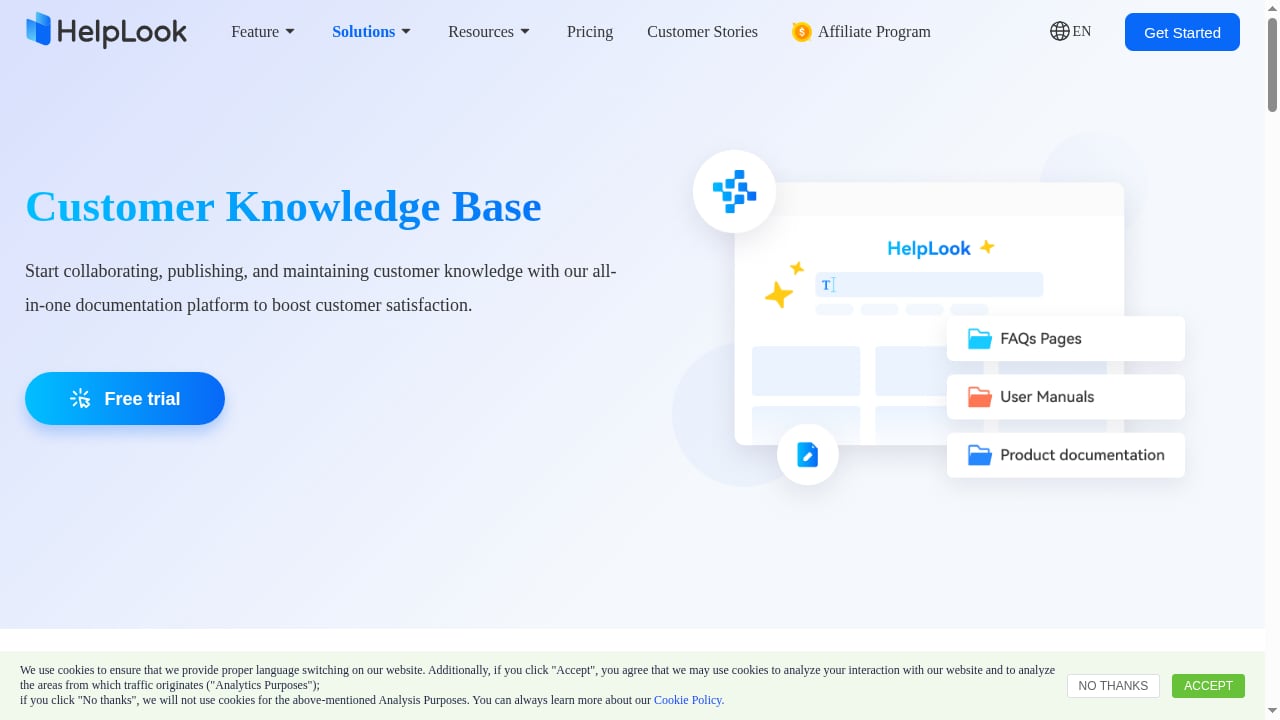
First viewport screenshot of Best Help Center Software & Knowledge Base 2025 - HelpLook.
| Platform | Billing Unit | Entry Price | Standalone Helpdesk? |
|---|---|---|---|
| Fin | Per outcome | $0.99/outcome, 50 minimum | No (adds to existing) |
| Zendesk AI | Per agent | $25/agent/month | Yes |
| Freshdesk | Per agent | $18/agent/month | Yes |
| Ada | Custom | Custom | No |
| Gorgias | Per seat + per resolution | $10/50 tickets + $1/resolution | Yes |
| Help Scout | Per AI resolution | $0.75/resolution | Yes |
| Tidio | Per AI conversation | $32.50/month for 50 | Yes |
| Chatbase | Per message credit | $40/month for 700 | Partial |
| Crisp | Per plan tier | $45/month | Yes |
| Decagon | Custom | Custom | No |
How to Choose: A Decision Framework
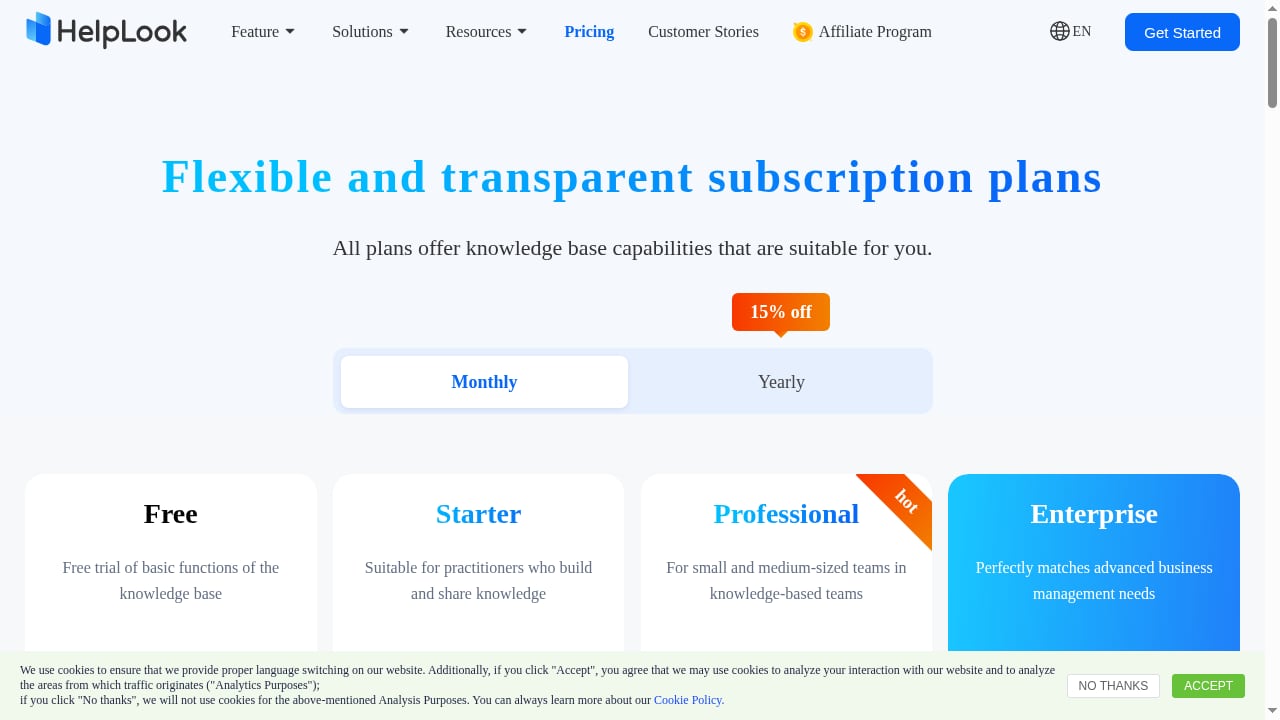
First viewport screenshot of HelpLook Pricing - AI-Powered Knowledge Base & Help Desk Software.
Start with the work you need done, not the product name. Ask these questions:
Does the AI need to answer from documentation, or take actions in connected systems? Answering is easier; actions require identity checks, permissions, and failure paths. "Integrates with" is not enough.
Do you already have a helpdesk? If yes, an AI layer like Fin, Ada, or Help Scout AI Answers may be the fastest path. If no, an integrated suite like Zendesk, Freshdesk, or Gorgias may be simpler.
How does the vendor bill? Per seat, per resolution, per conversation, per outcome, or per message credit all produce different costs at scale. Model your expected volume before signing.
What happens when the AI is wrong? Look for source citations, review workflows, gap reports, and clear escalation paths.
How fresh is the knowledge? Some platforms auto-sync weekly; others require manual refresh. If your policies change often, confirm who owns refreshes.
For teams that need a strong knowledge layer beneath their AI support stack, a dedicated knowledge base platform can complement these tools. HelpLook is an AI-powered knowledge base and help desk platform that some teams use alongside a customer service AI platform to manage help centers, FAQs, and internal knowledge. It is not a customer service AI platform and is not ranked here, but it can be relevant when your AI answers depend on well-organized, searchable documentation. For a broader view of that adjacent category, see our comparison of AI knowledge base and customer support automation platforms.
Related reading
- HelpLook vs Mintlify vs Stonly: Which Platform Fits? - Compare HelpLook, Mintlify, and Stonly on audience, AI search, no-code editing, SEO, integrations, and pricing to pick the right knowledge platform.
FAQ
What is the difference between a customer service AI platform and a chatbot?
A chatbot answers through conversation. A customer service AI platform can also follow workflows, use connected tools, and take approved actions such as processing a refund or updating an order. The labels overlap, so check whether the system can complete your specific use case.
Which customer service AI platform is best for small teams?
Tidio, Chatbase, and Freshdesk are common starting points for small teams because of lower entry pricing and simpler setup. Help Scout AI Answers is a strong fit if you already use Help Scout. The right choice depends on your existing stack and expected ticket volume.
How much should I budget for a customer service AI platform?
Costs vary widely by billing model. Per-agent plans start around $18–$25 per agent per month. Outcome-based pricing can run $0.75–$0.99 per resolution or outcome. Model your expected monthly volume across both human and AI interactions before committing.
Can AI fully replace human support agents?
No. Every platform in this ranking includes human handoff for complex or sensitive issues. AI is best at deflecting routine queries and assisting agents, not replacing judgment, empathy, or escalation handling.
How do I evaluate AI answer accuracy before buying?
Ask vendors for source citation capabilities, review and correction workflows, and gap reports that show unanswered questions. Run a pilot with your own documentation and measure how often the AI resolves issues without escalation.
Conclusion
The best customer service AI platform for 2026 depends on your existing stack, your billing tolerance, and the complexity of the work you need automated. Fin leads for teams adding AI to an existing helpdesk. Zendesk and Freshdesk are strong all-in-one choices. Gorgias is the clear pick for ecommerce. Ada and Decagon suit enterprises that need conversational AI or knowledge-work automation. Tidio, Chatbase, Help Scout, and Crisp serve smaller or documentation-focused teams well.
Whichever platform you choose, the quality of your underlying knowledge base determines how well the AI performs. Invest in organized, current documentation first, then let the AI platform do its job. For more comparisons, see our guide to self-hosted enterprise wiki software and our HelpLook vs Stonly vs DocsBot comparison.