
HelpLook vs The Customer Service AI Platform: Which Fits Modern Support Teams?
Support leaders in 2026 face a familiar squeeze: ticket volume keeps rising, headcount stays flat, and customers expect instant answers. Two very different answers dominate the conversation. One is an AI-powered knowledge base and help desk platform like HelpLook. The other is a customer service AI platform that resolves issues automatically with AI agents.
They sound similar in a demo. They are not similar in practice. This comparison breaks down where each approach wins, where it struggles, and how to decide for your team.
Quick answer: the core difference
First viewport screenshot of Customer Success Stories & AI Support Case Studies.
HelpLook is an all-in-one platform for building knowledge bases, help desks, and self-service support experiences. Its strength is the knowledge layer: no-code content creation, AI-powered search, SEO-optimized help centers, customizable portals, widgets, and analytics. Trusted by over 10,000 companies, it serves editors, support teams, content creators, and operations professionals across SaaS, e-commerce, legal, healthcare, financial services, and education.
The Customer Service AI Platform for Modern Support Teams is positioned around outcomes: lower support costs and better customer experiences through AI agents that resolve customer issues automatically.
The distinction matters. HelpLook invests in the source of truth that answers come from. The substitute invests in the automation that delivers answers. Most mature support organizations eventually need both capabilities, but the order in which you adopt them changes your results.
What HelpLook does well
HelpLook vs The Customer Service AI Platform: 2026 Comparison - Where the customer service AI platform substitute is strong.
Knowledge as a first-class asset
HelpLook treats your help content as a product, not a side project. Teams can create and manage customer-facing help centers, internal knowledge bases, product manuals, enterprise blogs, FAQs, user guides, and troubleshooting content without writing code. That breadth matters for e-commerce teams publishing product manuals and SaaS teams maintaining release notes alongside support articles.
AI search grounded in your own content
AI-powered search helps users find answers quickly, which is the mechanism behind reduced support costs. When search is grounded in curated documentation, deflection improves without the hallucination risk that comes from ungrounded generation.
SEO and discoverability
SEO optimization is built into the platform. For many teams, this is the quiet advantage: customers who find an answer through a search engine never open a ticket at all. Self-service starts before your help center.
No-code operations and analytics
A low-code, ready-to-use SaaS model means support and content teams can ship portals, widgets, and updates without engineering tickets. Analytics close the loop by showing what customers search for and where content gaps remain.
Where the customer service AI platform substitute is strong
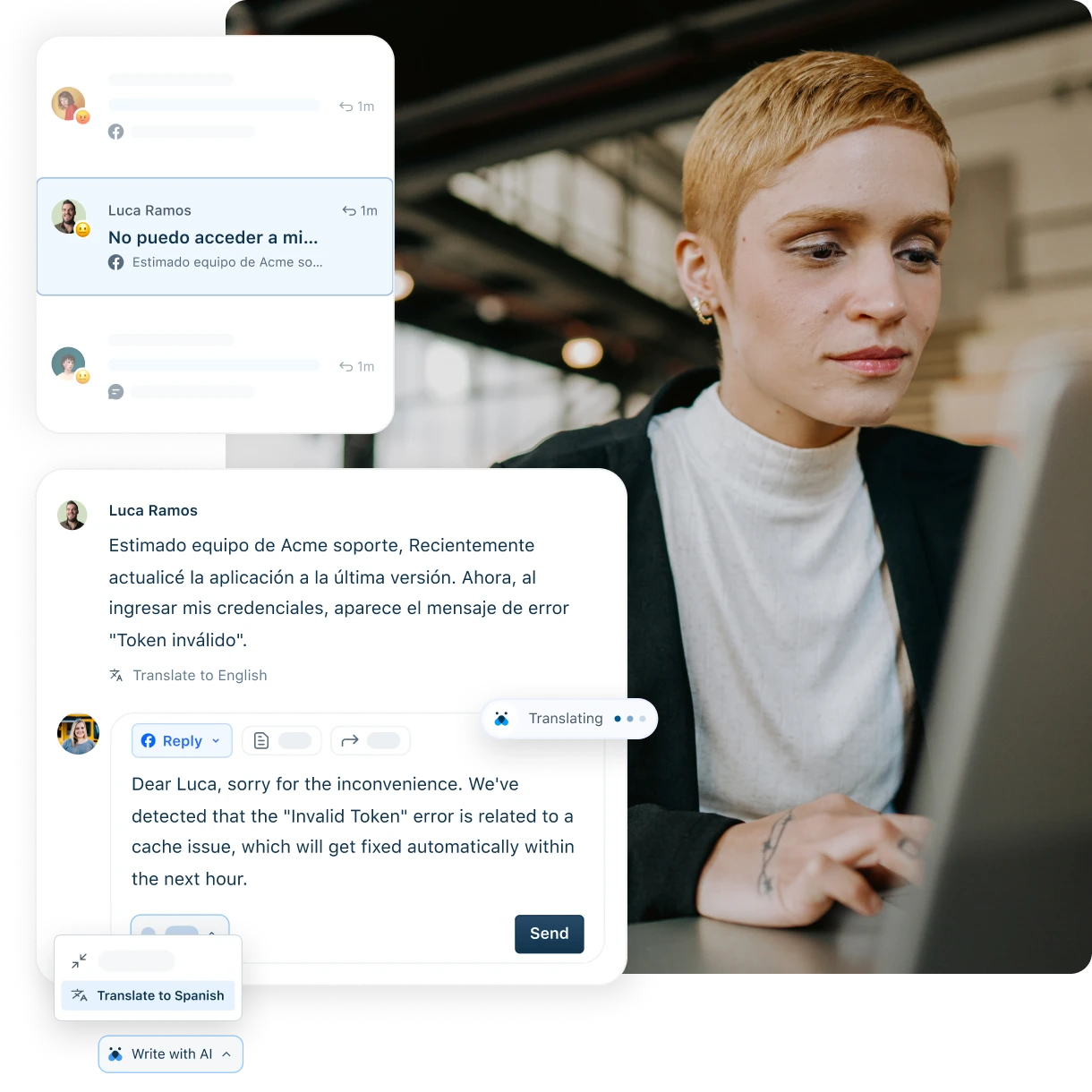
The Customer Service AI Platform for Modern Support Teams product interface.
The substitute's pitch is direct: AI agents that resolve customer issues automatically. For high-volume, repetitive contact reasons, that is a compelling value proposition, and it aligns with the broader 2026 shift from passive assistants to active agents that read, classify, draft, and act with human supervision.
If your primary pain is agent workload on predictable tickets, an automation-first platform addresses it head-on. The trade-off is that autonomous resolution quality depends heavily on the knowledge and context available to the agents. Automation without a maintained knowledge base tends to produce confident but wrong answers, which increases escalations and erodes trust.
Head-to-head comparison
HelpLook vs The Customer Service AI Platform: 2026 Comparison - Head-to-head comparison.
| Dimension | HelpLook | The Customer Service AI Platform |
|---|---|---|
| Primary focus | Knowledge base, help desk, self-service | AI agents resolving issues automatically |
| Content creation | No-code, multi-format (help centers, manuals, blogs, FAQs) | Not the core emphasis |
| AI search | Grounded in your curated content | Agent-driven resolution |
| SEO for help content | Built-in optimization | Not a stated strength |
| Customization | Customizable portals and widgets | Platform-defined experience |
| Analytics | Content and search analytics | Support cost and resolution metrics |
| Best fit | Teams building durable self-service | Teams automating high-volume resolution |
Which should you choose?
Choose HelpLook if your bottleneck is content quality, discoverability, or self-service coverage. Teams with fragmented documentation, weak search, or no SEO presence get compounding returns from fixing the knowledge layer first. This is also the safer starting point if your contact reasons are diverse and unpredictable.
Choose the customer service AI platform if your knowledge is already solid and your bottleneck is repetitive ticket volume. Automation multiplies the value of good content. It does not substitute for it.
Consider both if you are scaling support without proportional headcount growth. A practical sequence is to consolidate knowledge in HelpLook, measure which searches and articles deflect the most tickets, then layer automation on top of that foundation. For a deeper look at integration patterns, see how to use HelpLook with an AI-powered ITSM platform.
Practical evaluation checklist
- Audit your current deflection rate and top 20 contact reasons.
- Check whether your existing content can support grounded AI answers.
- Test search quality on real customer phrasing, not internal terminology.
- Measure how much traffic reaches your help center organically.
- Confirm the platform supports your content formats (manuals, guides, FAQs, internal repositories).
- Verify analytics can attribute ticket reduction to specific content.
If steps 1 through 3 reveal weak content coverage, automation will amplify the problem rather than solve it. If they reveal strong content with high repeat volume, automation becomes the higher-leverage investment.
Related reading
- HelpLook vs Knowledge Base Software vs eGain: 2026 Comparison - Compare HelpLook, hosted knowledge base software, and eGain for AI search, self-service, SEO, and enterprise CX. Find the right fit for your team.
Sources and further reading
- The 9 best AI email assistants in 2026: from inbox helpers to autonomous agents · Missive Blog - The best AI email assistants in 2026: Missive, Shortwave, Superhuman, Fyxer, SaneBox, and more. Compare features, pricing, and which fits your team.
- Best 15 Customer Feedback Management Software Compared - Compare the best customer feedback management software by features, pricing, and use case. Find the right tool to collect, analyze, and act on feedback.
- Customer Data Platforms 101 - What is a customer data platform (CDP), what can it do and how does it differ from other solutions, like CRMs, DMPs, MSPs or data lakes?
Frequently asked questions
Is HelpLook a replacement for a customer service AI platform?
Not exactly. HelpLook covers knowledge base creation, help desk, self-service, AI search, and SEO. A customer service AI platform focuses on autonomous issue resolution. They overlap in AI-assisted support but solve different layers of the problem.
Can AI agents work without a knowledge base?
They can run, but resolution quality suffers. Agents grounded in curated, current documentation produce more accurate answers. Ungrounded automation increases the risk of incorrect resolutions and escalations.
Which is better for small support teams?
Small teams usually benefit more from HelpLook first, because self-service and SEO reduce inbound volume without requiring complex automation setup. Automation-first platforms tend to pay off at higher ticket volumes.
Does HelpLook support internal knowledge bases?
Yes. HelpLook supports both customer-facing help centers and internal knowledge repositories, which is useful for support, operations, and content teams working from the same source of truth.
How should I compare pricing?
Compare total cost of ownership: content migration effort, seats for editors and agents, automation usage limits, and the engineering time each option requires. A lower headline price can cost more if setup demands developer resources.
Conclusion
HelpLook and The Customer Service AI Platform for Modern Support Teams are not direct substitutes so much as sequential investments. HelpLook builds the knowledge foundation that makes self-service work and makes AI answers trustworthy. The customer service AI platform automates resolution once that foundation exists.
If your documentation is scattered or your help center is invisible to search engines, start with HelpLook. If your content is strong and repetitive tickets are consuming your team, automation is the next lever. For teams comparing a wider field, see the customer service AI platform review and the top 10 AI-powered documentation platforms for 2026 to benchmark alternatives before committing.