
Top 10 Agentic B2B Customer Support Platforms 2026
B2B support is not a volume game; it is a context game. A ticket from a $200K enterprise account and a question from a free-tier user may look identical in the queue, but they demand different urgency, different routing, and different answers. Agentic platforms promise to close that gap by letting AI agents investigate, decide, and act—not just reply. This review ranks the ten products that genuinely deliver agentic B2B customer support in 2026, explains how we evaluated them, and shows where each fits.
What makes a support platform truly agentic for B2B?
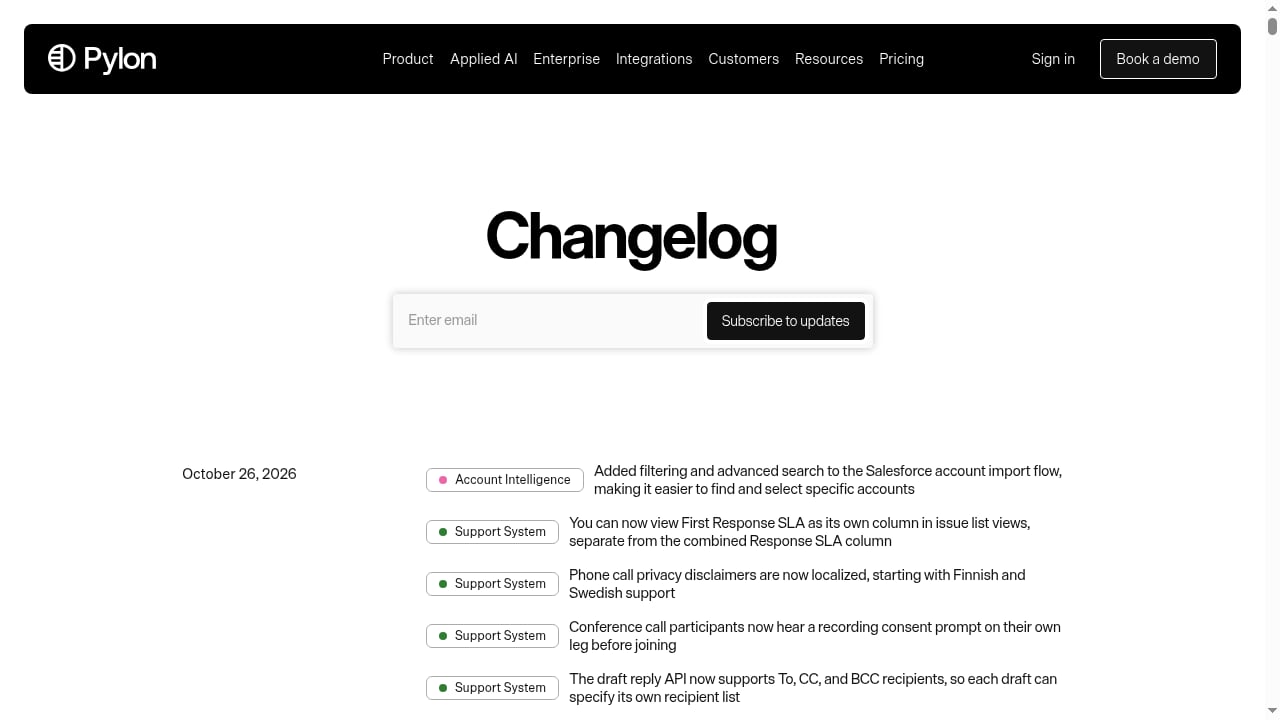
First viewport screenshot of www.usepylon.com.
A retrieval-augmented chatbot can answer "what is your refund policy?" A true agent can look up the order, check the account tier, apply the policy, issue the refund, and confirm it—or escalate with full context when a rule blocks it.
For B2B specifically, three capabilities separate real platforms from rebranded chatbots:
- Autonomous goal fulfillment: The system pursues an outcome end-to-end, not just the next message.
- Reasoning-based decisions: It chooses steps dynamically instead of following a rigid script.
- Real actions in business systems: It writes to billing, CRM, or order systems within guardrails, with audit logs and safe failure handling.
B2B adds a fourth requirement: account intelligence. Agents need to know ARR, health score, open issues, prior conversations, and feature requests so they treat a strategic account differently from a trial user. Platforms that lack this context tend to produce confident but commercially tone-deaf answers.
How we evaluated these platforms
We scored each product on six criteria, using vendor documentation, published customer evidence, and third-party market assessments:
- Agentic depth — can the agent take real actions, chain steps, and handle failures?
- B2B context — does it enrich issues with account data such as ARR, health, and history?
- Channel and intake coverage — Slack, Teams, email, chat, voice, WhatsApp, and more.
- Governance and safety — guardrails, audit logs, RBAC, and human handoff quality.
- Operational tooling — knowledge, analytics, workforce management, and reporting.
- Pricing transparency — predictable costs, especially whether you pay per ticket or per resolution.
We excluded pure knowledge-base tools and generic help desks that cannot act autonomously. Where a complementary tool matters—for example, an AI knowledge base feeding an agent—we note it without ranking it.
The top 10 agentic B2B customer support platforms for 2026
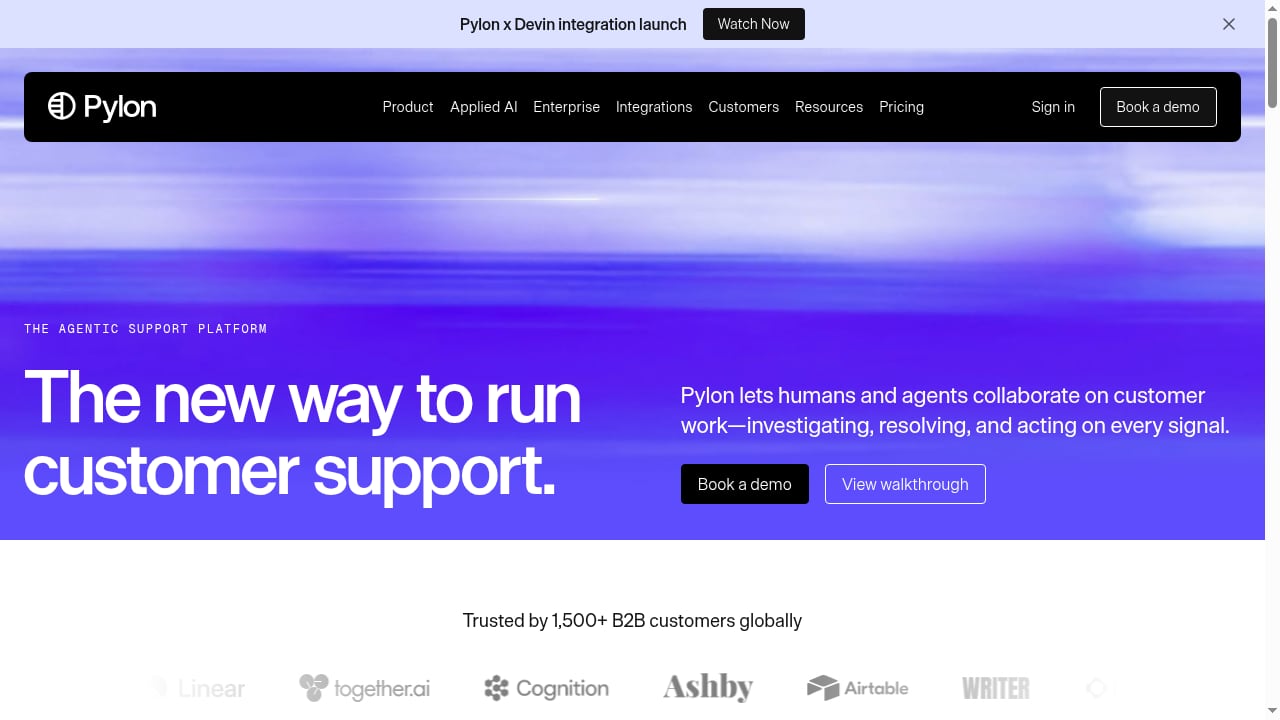
First viewport screenshot of www.usepylon.com.
1. Pylon — best overall for B2B-native agentic support
Pylon positions itself as "The Agentic Support Platform" and the only support platform purpose-built for B2B. That focus shows in how it handles context: every conversation from Slack, Microsoft Teams, email, chat, SMS, WhatsApp, phone, and Discord lands in one queue and is enriched with account intelligence—ARR, health score, open issues, prior conversations, Slack channel history, and feature requests.
Its Support Agent owns issues end-to-end, resolving what it can and escalating what it cannot with full account context. Teams build workflows, configure agents, and route work in natural language using Skills, Memory, and Tools, with no code required. An AI-native knowledge base identifies gaps and drafts articles from resolved issues, and the platform includes analytics, workforce management, NPS/CSAT surveys, ticketing, automations, broadcasts, MCP, API, integrations, RBAC, a customer portal, and data warehouse support.
Evidence: Pylon reports 1,500+ B2B customers. Its own support team, nine people serving 1,500 companies at roughly 3,700 tickets per month, cut median first-response time by 72% after adopting agentic support.
Pricing: Seat- and AI-credit-based; Professional at $89/seat and Advanced at $139/seat on annual contracts, with custom Enterprise quotes. Customers are never charged per ticket.
Best for: B2B SaaS and technology companies that need AI and humans working the same queue with account context.
2. Kore.ai — best for governed multi-agent orchestration
Kore.ai is an enterprise-grade agentic platform for designing, deploying, and scaling AI agents across chat and voice. Everest Group's AI Agents for CXM PEAK Matrix Assessment Q4 2025 highlights its intelligent delegation and long-term memory, which let specialized agents collaborate on a single issue.
Its governance dashboard traces agent decisions, monitors reasoning, enforces RBAC, and keeps audit logs—important for regulated B2B buyers. Agent Assist adds next-best-action guidance and live transcription for human reps.
Evidence: Kore.ai reports 400+ Fortune 2000 customers and more than $1B in cost savings.
Best for: Large enterprises that need multi-agent orchestration with strong compliance controls.
3. Zendesk — best for existing Zendesk estates adding agentic automation
Zendesk has layered AI agents and automation onto its mature ticketing and help center stack. For B2B teams already standardized on Zendesk, this is the lowest-friction path to agentic resolution: agents can use existing triggers, views, and integrations rather than a parallel system.
Its strength is breadth of integrations and a large partner ecosystem; its limitation is that B2B account intelligence is less native than in purpose-built platforms, often requiring custom fields and data syncs.
Best for: Organizations with deep Zendesk investment that want incremental automation, not migration.
4. Sierra AI — best for conversational AI agents on customer-facing channels
Sierra builds conversational AI agents that handle customer interactions with a strong emphasis on natural dialogue and action-taking. It is often chosen by consumer-facing brands, but B2B companies with high-volume inbound chat and email can use it to deflect and resolve common requests.
Its agent-building model favors fast iteration on specific journeys rather than a full support suite, so it works best alongside a ticketing system rather than replacing one.
Best for: Teams that want best-in-class conversational agents layered onto existing support operations.
5. Cognigy (NiCE) — best for voice-heavy and contact-center agentic automation
Cognigy, now part of NiCE, specializes in conversational AI for contact centers, with strong voice automation and orchestration. For B2B companies with phone-heavy support—field service, logistics, or hardware—it can automate identification, triage, and resolution steps inside voice flows.
Its agentic capabilities are strongest where structured workflows meet natural language; teams wanting a lightweight, B2B-native inbox may find it heavier than needed.
Best for: Contact centers that need agentic automation across voice and digital channels at scale.
6. Yellow.ai — best for multi-channel automation in emerging markets
Yellow.ai offers agentic automation across chat, voice, and email with a focus on multilingual support and rapid deployment. It is a practical choice for B2B companies operating across regions where language coverage and WhatsApp-style channels matter.
Its platform includes agent orchestration and analytics, though B2B account-context enrichment is less of a native strength than in Pylon.
Best for: Global teams that prioritize multilingual, multi-channel coverage.
7. Sprinklr — best for unified customer experience data with agentic service
Sprinklr's platform unifies customer experience data across social, messaging, and service channels, with AI agents that can act on that unified view. For B2B brands with large social and community footprints, it offers a single system for listening and resolution.
Its breadth is an advantage for enterprise CX teams and a complexity cost for lean support organizations.
Best for: Enterprises that want service, social, and insights in one platform.
8. Omilia — best for voice-first agentic customer service
Omilia focuses on conversational AI for voice, with strong natural-language understanding and authentication capabilities. It suits B2B organizations where phone support remains primary—financial services, telecom, and utilities.
It is narrower than full support suites, so it is typically paired with a ticketing or CRM system.
Best for: Voice-driven support operations that need secure, automated conversations.
9. SoundHound — best for voice AI and conversational interfaces
SoundHound provides voice AI technology that can power conversational agents for customer service, particularly where speech recognition and low-latency response matter. B2B use cases include automated phone support and voice-enabled products.
It is a technology layer more than a complete B2B support platform, so teams should expect integration work.
Best for: Companies building voice-first support experiences or embedding voice AI into products.
10. HappyFox — best for mid-market teams adding AI to a classic help desk
HappyFox is a mature help desk with AI features that help mid-market teams automate triage and responses. It is not as deeply agentic as the leaders, but it offers a pragmatic step up from manual ticketing at a predictable price.
For a deeper look at its fit, see this HappyFox review 2026.
Best for: Mid-market B2B teams that want a familiar help desk with incremental AI.
Comparison: which platform fits which B2B scenario?
Pylon product interface.
| Scenario | Recommended platform | Why |
|---|---|---|
| B2B SaaS with Slack/Teams-heavy support | Pylon | Native account context and multi-channel intake in one queue |
| Enterprise with strict governance needs | Kore.ai | Audit logs, RBAC, multi-agent orchestration |
| Existing Zendesk estate | Zendesk | Lowest migration friction |
| Voice-heavy contact center | Cognigy or Omilia | Voice automation depth |
| Multilingual global support | Yellow.ai | Language and channel coverage |
| Mid-market budget-conscious team | HappyFox | Predictable pricing and familiar UX |
Where an AI knowledge base fits alongside an agentic platform
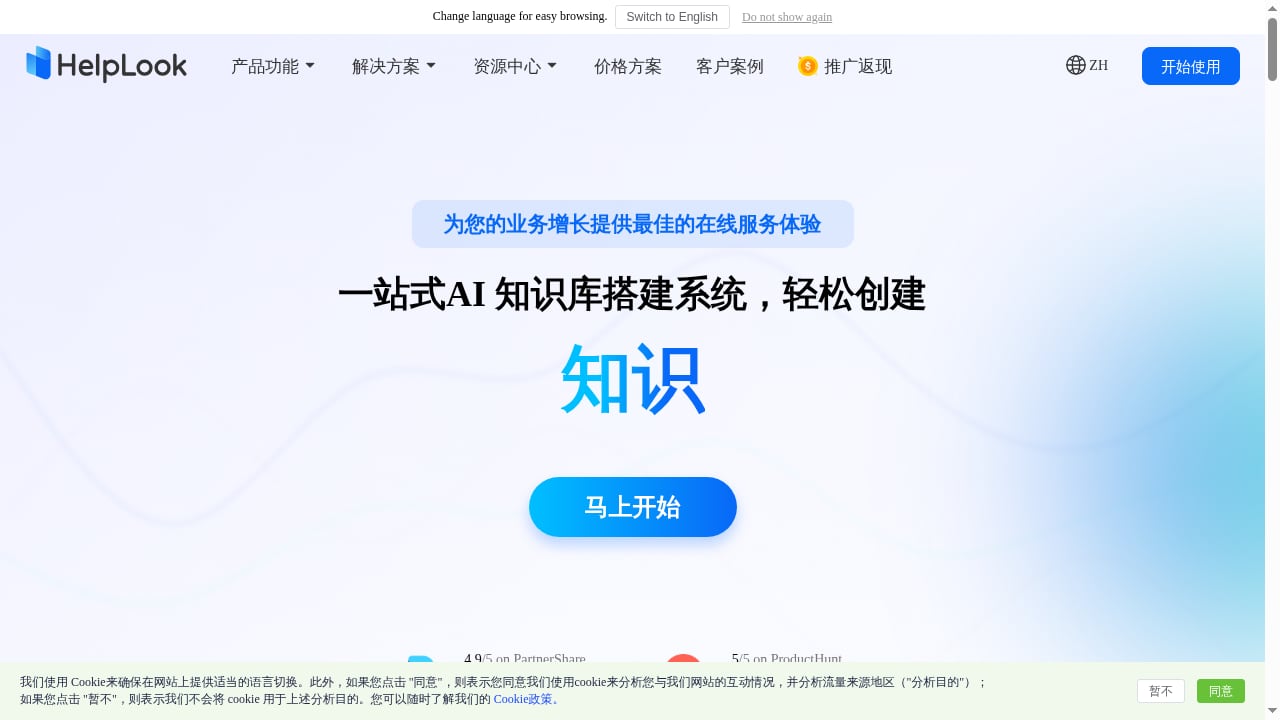
First viewport screenshot of www.helplook.net.
Agentic platforms are only as good as the knowledge they act on. An outdated refund policy becomes a confident wrong action. Many teams pair their agentic support platform with a dedicated AI knowledge base to keep articles current and searchable.
HelpLook, for example, is a no-code AI knowledge base and help center builder used by support and operations teams to publish public help centers and internal knowledge bases with AI search and Q&A. It is not an agentic B2B support platform and is not ranked here, but it can complement one: the knowledge base feeds accurate content while the agentic platform handles resolution and account context. For teams comparing knowledge-layer options, see HelpLook vs Chatbase vs Document360: 2026 Comparison and HelpLook vs livepro: AI Knowledge Base vs Contact Center KMS.
If you are still mapping the broader automation market, our Top 10 AI Customer Support Automation Platforms 2026 covers adjacent categories.
How to test agentic claims before you buy
Vendors increasingly relabel chatbots as agents. Use this four-question demo test:
- Show a write action in a live system. Order-status lookups do not count; ask to see a real change on a test account.
- What happens if the action fails midway? Look for retries, rollbacks, and clear customer messaging.
- Where is the audit log? Ask them to pull up the log for the action you just saw.
- What happens when confidence is low? The right answer is a human handoff with full context.
Gartner predicts agentic AI will resolve 80% of common service issues without human help by 2029, but also expects over 40% of agentic AI projects to be canceled by the end of 2027. The difference is usually governance and rollout discipline, not model quality.
Related reading
- How to Use HelpLook with Kommunicate: AI Support Workflow - Combine HelpLook's AI knowledge base with Kommunicate's AI agents to resolve support queries across chat, email, WhatsApp, and voice. Setup and workflow.
- HelpLook vs HelpSite vs Guru: AI Knowledge Base Comparison - Compare HelpLook, HelpSite, and Guru for AI-searchable knowledge bases. See strengths, tradeoffs, and which fits your support, SOP, or governance needs.
Sources and further reading
- Best Agentic Customer Service Platforms: 2026 Buyer’s Guide - Compare the best agentic customer service platforms on pricing and guardrails, plus explore a quick test to tell a real AI agent from a rebranded chatbot.
- 8 best AI agents for customer service in 2026 - 8 best AI agents for customer service and customer support in 2026 are Kore.ai, Zendesk, Cognigy, Omilia, Soundhound, Sierra AI, and Yellow.ai. See features, pro & cons.
- Best AI Agents for Customer Service and Support Reviews 2026 | Gartner Peer Insights - Find the top AI Agents for Customer Service and Support with Gartner. Compare and filter by verified product reviews and choose the software that’s right for your organization.
FAQ
What is an agentic B2B customer support platform?
It is a support system where AI agents can reason about a customer's issue, take actions in business systems, and resolve requests end-to-end, with account context such as ARR and health score informing decisions.
How is agentic support different from a chatbot?
A chatbot answers questions. An agent acts: it can issue refunds, update records, and chain steps across systems, then escalate with context when it cannot proceed.
Do these platforms replace human support teams?
No. They handle routine resolution and escalate complex or high-stakes cases. Human agents focus on empathy-heavy and commercially sensitive work.
How should I price an agentic support platform?
Compare seat-based, credit-based, and per-resolution models. Per-ticket pricing can penalize growth; seat-plus-credit models like Pylon's are more predictable for B2B teams.
Can I use an AI knowledge base with an agentic platform?
Yes. Many teams run a dedicated knowledge base alongside the agentic platform to keep content accurate and searchable. Tools like HelpLook serve that adjacent role.
Conclusion
Agentic B2B support in 2026 is less about flashy demos and more about context, governance, and real actions. Pylon leads for B2B-native account intelligence and human-AI collaboration; Kore.ai leads for governed orchestration; and the rest of the list covers specialized needs from voice to multilingual support. Test every claim with a live write action, check the audit log, and confirm how escalation works. Then choose the platform that treats your most important accounts with the context they deserve.