
Top 10 AI Customer Support Automation Platforms for 2026
Customer support teams are drowning in repetitive questions. AI customer support automation platforms promise to resolve the repetitive majority—order status, password resets, how-to questions—so human agents can focus on complex, high-value conversations. But not all platforms are equal. Some are built into helpdesks, others sit on top of your existing stack, and pricing models range from per-seat to per-resolution.
This guide ranks the top 10 AI customer support automation platforms for 2026 based on transparent criteria, real-world evidence, and fit for different team sizes. Whether you're a small team looking for fast setup or an enterprise needing omnichannel automation, this list will help you decide.
How We Evaluated These Platforms
First viewport screenshot of quidget.ai.
We assessed each platform on six criteria:
- Automation depth: Can the AI resolve tickets end-to-end, or does it only suggest replies? Does it take actions like refunds or order edits?
- Channel coverage: Chat, email, voice, social messaging, and in-app support.
- Setup and time to value: How quickly can a team go live? Is no-code configuration available?
- Pricing transparency and model: Per seat, per resolution, per conversation, or flat monthly fee. We note hidden costs.
- Evidence of results: Published case studies, customer counts, and independent reviews.
- Scalability and compliance: Support for multiple languages, security certifications, and enterprise needs.
We prioritized platforms that genuinely belong to the AI customer support automation category—not adjacent tools like knowledge bases or CMS platforms. For teams that need a strong knowledge foundation to power their AI, complementary tools like HelpLook's AI knowledge base can be paired with these platforms.
The Top 10 AI Customer Support Automation Platforms for 2026
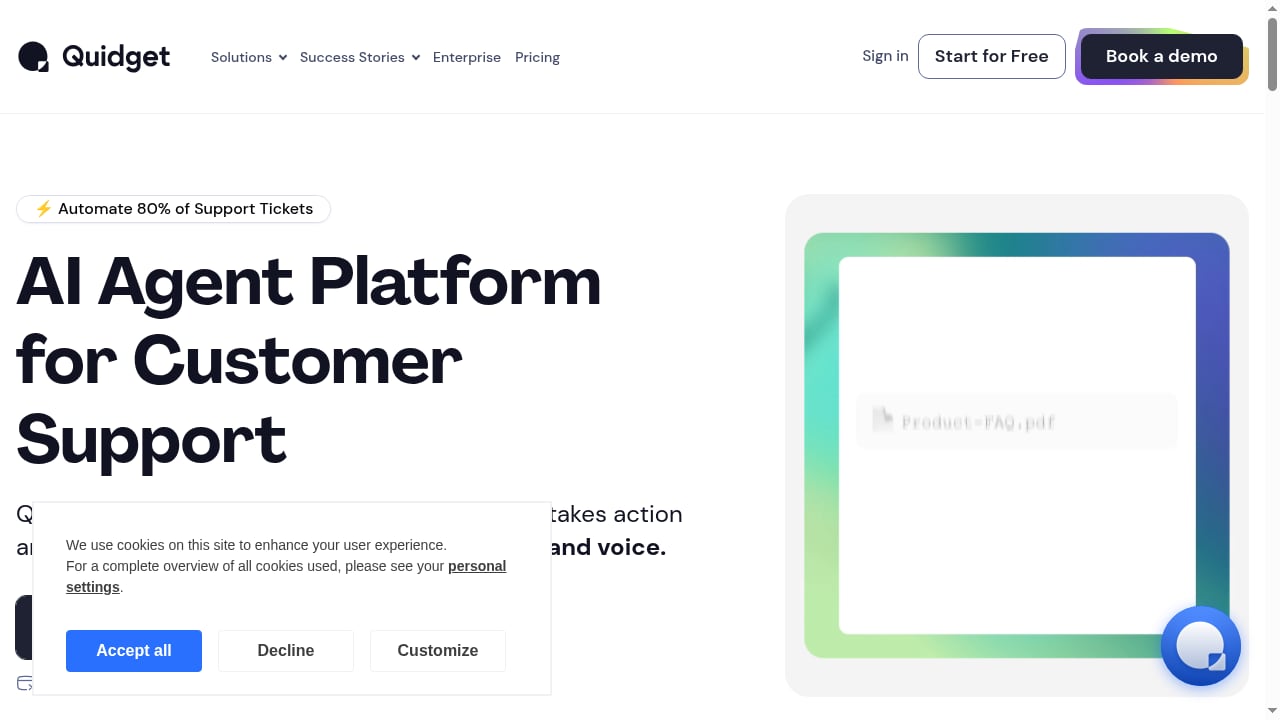
First viewport screenshot of quidget.ai.
1. Quidget
Best for: Small to mid-sized teams wanting fast, pay-per-resolution AI support across chat, email, and voice.
Quidget is an AI agent platform that automates routine support conversations. Trained on your own data—documents, articles, URLs, and FAQs—it aims to resolve 80% of support tickets, answer questions, qualify leads, and convert visitors. Setup takes about two minutes, and you can build an agent for free with no credit card required.
Key strengths:
- Multi-channel support: live chat, email, and voice.
- Flow Builder for bot logic and a Training area with folder organization.
- Sub-second accurate replies for common "How do I...?" and "Where is my...?" queries.
- Pay-only-for-AI-resolved billing: no charges for failed answers, test chats, or human handoffs.
- Global auto-translate for multilingual conversations.
- WordPress plugin for no-code installation.
Considerations: While Quidget reports being trusted by 100+ brands, it may lack the deep enterprise integrations of larger suites. It's an excellent fit for small teams prioritizing speed and cost control.
2. Zendesk AI
Best for: Large support teams already using Zendesk.
Zendesk AI adds AI agents, Copilot, and intelligent triage to the Zendesk helpdesk. It leverages your existing knowledge base and ticket history to automate responses and route complex issues. Pricing starts at $19/agent/month plus $1.50–$2.00 per automated resolution, according to eesel's 2026 comparison.
Key strengths: Deep integration with Zendesk workflows, strong analytics, and a mature ecosystem.
Considerations: Best for teams already committed to Zendesk; per-resolution costs can add up at high volumes.
3. Intercom (Fin)
Best for: Chat-first SaaS and ecommerce teams.
Intercom's Fin AI agent resolves customer queries across chat, email, and messaging channels. It's known for its conversational AI and automated workflows. Pricing starts at $39/seat/month plus per-resolution fees.
Key strengths: Excellent conversational interface, strong automation for common queries, and a unified inbox for agents.
Considerations: Seat-based pricing plus resolution fees may be costly for large teams; best for companies already using Intercom.
4. Freshdesk (Freddy AI)
Best for: Small and mid-sized businesses on a budget.
Freshdesk's Freddy AI provides bots, ticketing automation, and sentiment analysis. It offers a free plan and paid plans starting at $48.99/agent/month (Pro), with AI sessions priced separately.
Key strengths: Affordable entry point, solid automation for SMBs, and integration with the Freshworks suite.
Considerations: AI capabilities are less advanced than enterprise-focused platforms; per-session fees apply after a threshold.
5. Salesforce Service Cloud (Agentforce)
Best for: Enterprises deeply embedded in the Salesforce CRM ecosystem.
Agentforce uses CRM data to power AI agents that can handle service cases, classify tickets, and provide predictive insights. Pricing starts at $25/user/month for Starter Suite, with Agentforce at $2 per conversation.
Key strengths: Unmatched access to customer data, robust automation, and scalability.
Considerations: Requires Salesforce investment; implementation can be complex and costly.
6. Gorgias
Best for: Shopify and ecommerce brands.
Gorgias's AI Agent reads and edits live orders, handles returns, and answers product questions. Pricing starts at $10/month for 50 tickets plus $0.85–$1.00 per automated interaction.
Key strengths: Deep ecommerce integrations, order management actions, and a focus on revenue generation.
Considerations: Best for ecommerce; less suited to B2B or SaaS support.
7. Ada
Best for: Large consumer brands needing omnichannel automation.
Ada provides AI agents across chat, email, and voice, with no-code playbooks and multilingual support. Pricing is custom (contact sales).
Key strengths: Enterprise-grade automation, strong multilingual capabilities, and a focus on resolution.
Considerations: Sales-led, no self-serve option; may be overkill for small teams.
8. Sierra
Best for: Enterprises wanting outcome-based pricing.
Sierra builds AI agents from standard operating procedures (SOPs) and supports voice. Pricing is custom and outcome-based.
Key strengths: Aligns costs with results, strong for complex workflows, and built for large-scale deployments.
Considerations: No transparent pricing; requires sales engagement.
9. Decagon
Best for: AI-first, high-volume CX teams.
Decagon uses natural-language agent logic (AOPs) across channels. Pricing is custom, per conversation or per resolution.
Key strengths: Designed for high automation rates, flexible agent logic, and modern architecture.
Considerations: Enterprise-focused; limited public pricing.
10. Tidio
Best for: SMB ecommerce stores and online brands.
Tidio's Lyro AI agent automates up to 75% of conversations, provides product recommendations, order updates, and lead qualification. Free plan available; paid plans from $29/month, with Lyro AI quotas priced separately.
Key strengths: Affordable, easy setup, and strong for small ecommerce teams.
Considerations: Less advanced automation for complex queries; AI quotas can limit usage.
Comparison Table: Top 10 at a Glance
First viewport screenshot of quidget.ai.
| Platform | Best for | Automation depth | Pricing model | Free trial |
|---|---|---|---|---|
| Quidget | Small/mid teams, fast setup | High (resolves routine tickets) | Pay per AI resolution | Free plan |
| Zendesk AI | Zendesk users | High (AI agents + copilot) | Per agent + per resolution | 14 days |
| Intercom (Fin) | Chat-first SaaS | High (conversational AI) | Per seat + per resolution | Yes |
| Freshdesk (Freddy AI) | SMBs | Medium (bots + automation) | Per agent + per session | 14 days |
| Salesforce Agentforce | Salesforce enterprises | High (CRM-powered) | Per user + per conversation | Yes |
| Gorgias | Ecommerce (Shopify) | High (order actions) | Per ticket + per interaction | 7 days |
| Ada | Large consumer brands | High (omnichannel) | Custom | No |
| Sierra | Enterprises, outcome-based | High (SOP-based) | Custom, outcome-based | No |
| Decagon | High-volume CX | High (AOPs) | Custom | No |
| Tidio | SMB ecommerce | Medium (Lyro AI) | Per conversation + AI quotas | Free plan |
How to Choose the Right Platform for Your Team
First viewport screenshot of quidget.ai.
Start by mapping your support volume and ticket types. If most tickets are repetitive (order status, FAQs), prioritize platforms with strong resolution rates and transparent per-resolution pricing like Quidget or Gorgias. If you're already on a helpdesk like Zendesk or Salesforce, their native AI may be the easiest add.
Consider your channel mix: chat-first teams may prefer Intercom, while ecommerce brands need order-editing capabilities like Gorgias. For enterprises with complex workflows, Ada, Sierra, and Decagon offer custom solutions.
Don't overlook the knowledge layer. AI agents are only as good as the data they're trained on. Pairing a platform with a robust knowledge base—such as HelpLook's AI-powered help center—can improve accuracy. For teams using eesel AI, integrating HelpLook creates a powerful combo.
Related reading
- HelpLook vs SAAS First: AI Knowledge Base or Help Desk? - Compare HelpLook and SAAS First for AI knowledge base vs help desk needs. See features, strengths, tradeoffs, and which fits your support stack.
- Chatbase Review 2026: AI Customer Support Tested - Evidence-based Chatbase review for 2026: features, pricing signals, setup, strengths, limits, and who should use it for AI customer support.
Sources and further reading
- 11 Best AI Customer Support Automation Platforms (2026) - Compare the 11 best AI customer support automation platforms for 2026 on automation depth, conversational AI, pricing, and SaaS-to-enterprise fit.
- 9 Best Customer Service Automation Software Tools for 2027 - A practical 2027 comparison of customer service automation software, focused on resolution depth, ecommerce fit, pricing models, implementation tradeoffs, and buying questions.
Frequently Asked Questions
What is an AI customer support automation platform?
It's software that uses AI—often conversational AI and machine learning—to automatically resolve customer inquiries across channels like chat, email, and voice, reducing the load on human agents.
How much do these platforms cost?
Pricing varies widely: from free plans (Quidget, Tidio) to per-resolution fees ($0.85–$2.00) or custom enterprise contracts. Always model your expected ticket volume to estimate total cost.
Can AI fully replace human agents?
No. Most platforms aim to automate 70–80% of routine tickets, escalating complex issues to humans. The best results come from a hybrid approach.
Which platform is best for small teams?
Quidget and Tidio offer fast setup and affordable pricing for small teams. Quidget's pay-per-resolution model and free tier make it particularly attractive.
Do these platforms support multiple languages?
Many do, including Quidget (auto-translate), Ada, and Helpshift. Check language coverage if you serve global customers.
Conclusion
The AI customer support automation market in 2026 offers options for every budget and scale. For small teams wanting speed and cost control, Quidget stands out with its pay-per-resolution model and two-minute setup. Enterprises should evaluate Zendesk AI, Salesforce Agentforce, or Ada for deep integration and scalability. Ecommerce brands will find Gorgias and Tidio well-suited to order management and product questions.
Whichever platform you choose, remember that AI is only as effective as the knowledge it's trained on. Invest in a structured knowledge base and continuously refine your AI agent's training data to maximize resolution rates and customer satisfaction.