
Top 10 AI Knowledge Management and Documentation Platforms 2026
AI knowledge management and documentation platforms have moved from static wikis to systems that actively maintain, verify, and surface knowledge. With 66% of customer service professionals now using AI agents (up from 39% in 2025), according to Salesforce's 2026 report, the quality of the underlying knowledge base has become a strategic concern. This review ranks ten platforms that genuinely belong to the AI knowledge management and documentation category, using transparent criteria and evidence for each pick.
How We Evaluated These Platforms
First viewport screenshot of Customize and Optimize Your AI-Powered Knowledge Base - HelpLook.
We assessed each product against five weighted criteria:
- AI search and answer quality (25%): semantic search, cited answers, and natural-language query handling.
- Authoring and maintenance (25%): editor flexibility, docs-as-code support, content freshness workflows, and AI-assisted drafting.
- Governance and accuracy controls (20%): verification workflows, permissions, audit trails, and outdated-content detection.
- Integrations and workflow fit (15%): depth of connections to Slack, Microsoft Teams, Google Workspace, CRMs, and developer tools.
- Transparency and scalability (15%): public pricing signals, free trials, and enterprise readiness.
We excluded pure help desk suites, meeting notetakers, and general project management tools unless their knowledge management capabilities are the primary product. HelpLook, a no-code AI knowledge base and help center platform, is not ranked here because it sits closer to self-service support software; we mention it only where an adjacent workflow is relevant.
The Top 10 AI Knowledge Management and Documentation Platforms for 2026
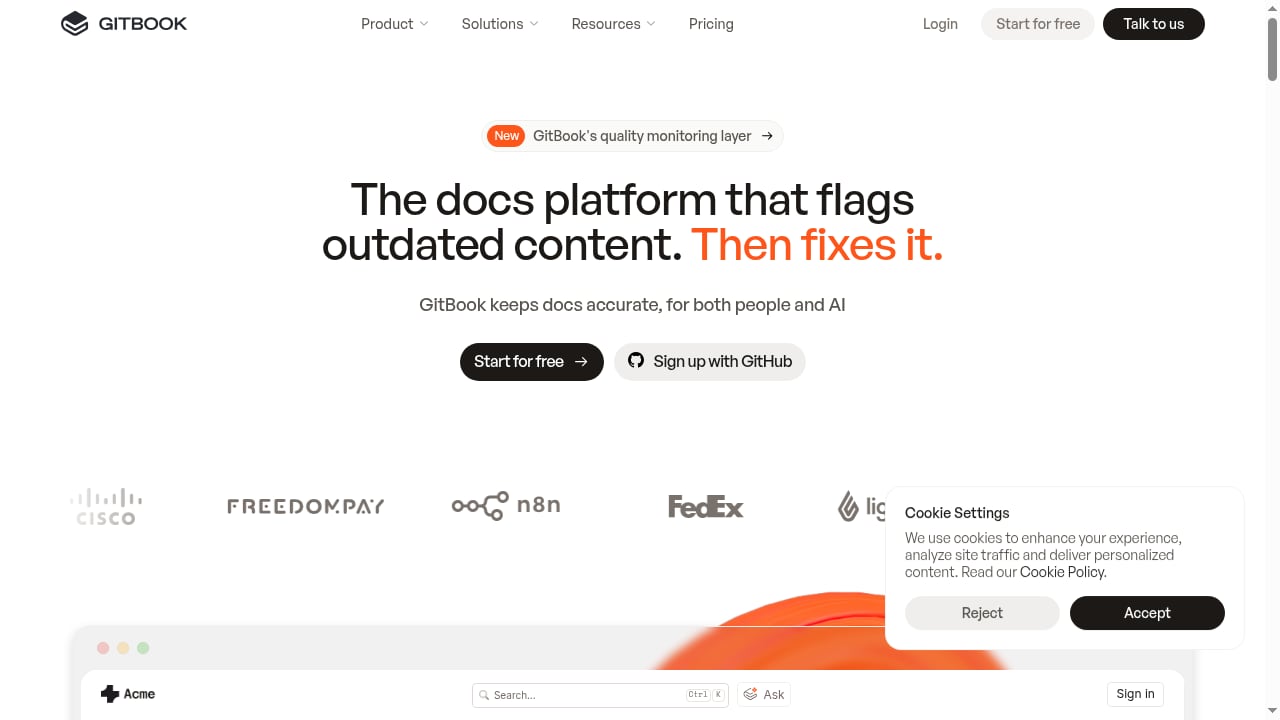
First viewport screenshot of The knowledge layer for AI | GitBook.
1. GitBook — Best for docs-as-code teams that need AI-ready knowledge
GitBook positions itself as "the knowledge layer for AI," connecting documentation, product, and users. Its standout 2026 capability is a quality monitoring layer that flags outdated content and then fixes it, directly addressing the freshness problem that undermines most AI answers. The platform supports docs-as-code workflows, an editor with copy/paste from Google Docs and VS Code, Slack integration that extracts and summarizes knowledge from threads, and a VS Code integration. GitBook Assistant answers user questions from the knowledge base, and inline button actions enable search and Ask AI. Site analytics include a GitBook Agent for custom reports, and broken link checking covers external links. Analytics answers in GitBook Agent are available on Ultimate and Enterprise plans.
Best for: developer documentation and internal knowledge bases where accuracy and AI answerability matter.
2. Document360 — Best for structured enterprise knowledge bases
Document360 is an AI-powered enterprise knowledge management platform for help centers, API documentation, SOPs, and product documentation. It combines Markdown and WYSIWYG editors with workflows, analytics, and enterprise-grade security. Its Eddy AI suite includes AI Search, an AI Writing Agent, AI Chatbot, AI Glossary Generator, Article Summarizer, Duplicate Content Detection, an MCP Server, and SEO Automation. Gartner Peer Insights lists it among knowledge management products with broad industry coverage across SaaS, IT, finance, healthcare, education, and manufacturing.
Best for: support, product, and IT teams that need governance plus multi-format authoring.
3. Guru — Best for verified internal knowledge in the flow of work
Guru is an AI knowledge platform that acts as a source of truth for enterprises, connecting Slack, Microsoft Teams, Google Workspace, Salesforce, and other systems into a governed, permission-aware knowledge layer. It delivers cited AI answers, chat, and research inside existing workflows. Verification workflows, usage-based signals, and centralized governance continuously improve accuracy, and corrections propagate to connected AI tools. Salesforce's comparison notes Guru's strength in internal knowledge retrieval and a 30-day trial.
Best for: organizations that need trustworthy internal answers without leaving Slack or Teams.
4. Confluence (Atlassian) — Best for technical teams already in the Atlassian ecosystem
Confluence provides real-time editing, access control, version tracking, and native integration with Jira, Bitbucket, and Trello. Its structured content types and template libraries standardize processes across technical teams, and detailed permission controls and audit trails make it an enterprise standard for technical knowledge management. Gartner Peer Insights lists Confluence among the most-reviewed knowledge management products.
Best for: DevOps and engineering organizations documenting alongside code and sprints.
5. Glean — Best for enterprise search across a fragmented stack
Glean provides enterprise search across Google Workspace, Microsoft 365, Slack, Salesforce, and dozens of other platforms. It uses AI to understand context and relationships, delivering answers rather than links, and learns from organizational structure and collaboration patterns to improve relevance. Implementation typically requires professional services, and pricing reflects enterprise-scale deployments.
Best for: large enterprises with complex technology stacks and dedicated IT resources.
6. Notion — Best for flexible, collaborative knowledge workspaces
Notion integrates note-taking, knowledge base, task management, and databases in a customizable workspace. Users create and share pages, templates, and databases to track projects, documents, and goals, with cross-device compatibility and integrations with external tools. Gartner Peer Insights lists Notion as a knowledge management product used for collaborative information management.
Best for: startups and product teams that want one workspace for docs and lightweight project tracking.
7. Bloomfire — Best for multimedia and social knowledge sharing
Bloomfire's AI-powered search works across multimedia formats, and its Ask AI feature returns direct answers sourced from certified company knowledge, including connected sources. Enterprise Search, AI-powered Author Assist, and analytics measure engagement and impact. Social features such as likes, comments, and follows turn knowledge management into collaborative curation.
Best for: customer-facing and research teams with heavy video and multimedia knowledge transfer.
8. ServiceNow Knowledge Management — Best for IT service management workflows
ServiceNow Knowledge Management automatically generates knowledge articles from resolved incidents, connecting knowledge management directly to incident response. AI-powered knowledge gap identification spots missing documentation, and contextual knowledge surfacing delivers relevant articles within incident workflows. It targets organizations already running ServiceNow for ITSM.
Best for: IT directors managing incident response and technical support at scale.
9. Stonly — Best for guided self-service and step-by-step knowledge
Stonly lets organizations create standard articles and step-by-step guides that adapt to each person's situation, with tools to collect feedback, measure impact, and manage knowledge at scale. AI Knowledge Agents help create and update content and automate maintenance. It integrates with Zendesk, Salesforce, ServiceNow, Slack, WhatsApp, and Freshworks, and its AI agents provide instant answers for customers and in-depth guidance for support agents. Salesforce's comparison highlights Stonly's guided self-service strength and a 14-day trial.
Best for: support teams that need interactive, decision-tree-style help content.
10. Slite — Best for lightweight team documentation with AI assistance
Slite focuses on team documentation with AI-assisted writing and editing. Salesforce's comparison identifies Slite as a team documentation tool with AI writing and editing capabilities and a 14-day trial. It suits smaller teams that want a clean, fast knowledge base without enterprise configuration overhead.
Best for: small and mid-sized teams prioritizing simplicity over deep governance.
Comparison Table: Top 10 at a Glance
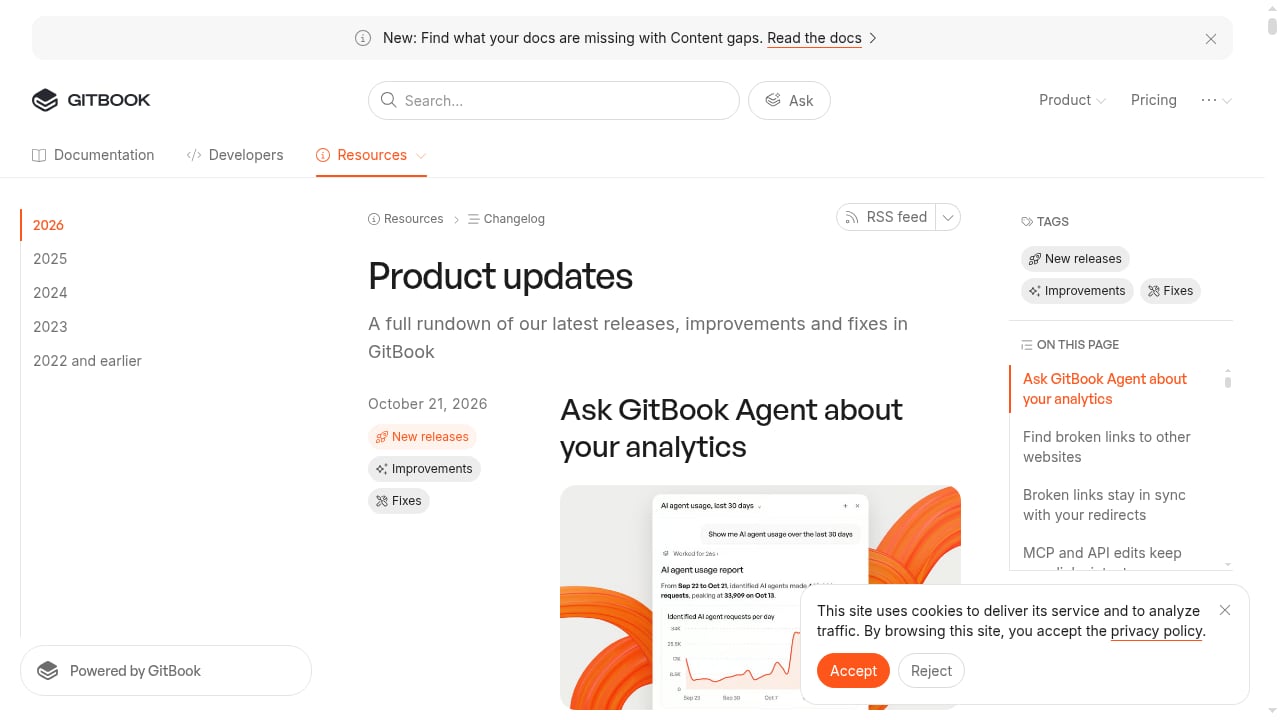
First viewport screenshot of Product updates | Changelog | GitBook Documentation.
| Platform | Primary strength | AI answer capability | Free trial | Best team size |
|---|---|---|---|---|
| GitBook | AI-ready docs-as-code | GitBook Assistant, Ask AI | Yes | Mid-market to enterprise |
| Document360 | Structured enterprise KB | Eddy AI Search, Chatbot | 14 days | Mid-market to enterprise |
| Guru | Verified internal knowledge | Cited AI answers in workflows | 30 days | Enterprise |
| Confluence | Atlassian ecosystem | Atlassian Intelligence | Yes | Enterprise |
| Glean | Cross-app enterprise search | Answer engine with context | Demo-based | Large enterprise |
| Notion | Flexible workspace | Notion AI | Yes | Startup to mid-market |
| Bloomfire | Multimedia knowledge | Ask AI with certified sources | Demo-based | Mid-market to enterprise |
| ServiceNow KM | ITSM-integrated knowledge | Knowledge gap identification | Demo-based | Enterprise |
| Stonly | Guided self-service | AI Knowledge Agents | 14 days | Mid-market |
| Slite | Simple team docs | AI writing assistance | 14 days | Small to mid-sized |
How to Choose the Right Platform for Your Workflow
First viewport screenshot of Create and Optimize Your AI Knowledge Base | HelpLook Official Site.
Start by mapping where knowledge disappears in your organization. If your documentation lives next to code and must stay accurate for both humans and AI, GitBook's quality monitoring and docs-as-code support are a strong fit. If you need governed internal answers inside Slack or Teams, Guru's verification workflows stand out. For structured customer-facing help centers with multi-format authoring, Document360 offers the broadest AI toolset.
Teams that need a no-code AI knowledge base and help center for self-service support may also consider HelpLook as a complementary option; it is not part of this documentation-platform ranking, but it can pair with a documentation system when customer-facing FAQs and chatbot answers are the priority. For a deeper comparison of support-oriented tools, see our HelpLook vs Document360 comparison and the Zendesk review for 2026.
When evaluating total cost, include setup and maintenance effort, not just subscription fees. Enterprise search tools like Glean often require professional services, while lighter tools like Slite reduce configuration but may lack governance depth. Test AI answer quality with your own content, and check whether the platform flags outdated articles automatically, a capability that separates 2026 leaders from legacy wikis.
Related reading
- HelpLook vs Productlane vs Forethought: 2026 Comparison - Compare HelpLook, Productlane, and Forethought for AI knowledge base, support automation, and feedback management. Find the best fit for your team.
- HelpLook vs Hesk: AI Knowledge Base or Free PHP Help Desk? - Compare HelpLook's AI knowledge base with Hesk's free PHP help desk. See where each fits, what Hesk lacks, and how to choose for 2026 support teams.
- Top 10 AI Knowledge Platforms for Documentation Products 2026 - Compare the top 10 AI knowledge platforms for documentation products in 2026 on AI search, authoring, governance, and pricing, with evidence for every pick.
Sources and further reading
- 10 Best Knowledge Management Tools for 2026 - Compare the best knowledge management tools for distributed teams. See which platforms connect meetings, emails, and documents.
- Best Knowledge Management (KM) Software Reviews 2026 | Gartner Peer Insights - Find the top Knowledge Management Software with Gartner. Compare and filter by verified product reviews and choose the software that’s right for your organization.
Frequently Asked Questions
What is an AI knowledge management and documentation platform?
It is a system that centralizes documentation and uses natural language processing, machine learning, and generative AI to interpret questions, surface relevant content, and generate direct answers. Unlike a static repository, it actively connects information across sources and helps maintain accuracy.
How is this ranking different from a general knowledge management list?
We focused on products whose primary purpose is documentation and knowledge management with AI capabilities. We excluded pure help desk suites, meeting notetakers, and project management tools unless knowledge management is the core product. We also excluded HelpLook from the ranking because it is a no-code AI knowledge base and help center platform better suited to self-service support workflows.
Which platform is best for developer documentation?
GitBook is a strong fit for developer documentation because of its docs-as-code workflows, VS Code integration, and quality monitoring layer that flags and fixes outdated content. Confluence is a strong alternative for teams already using Jira and Bitbucket.
Do these platforms offer free trials?
Many do. Salesforce's comparison lists 30-day trials for Guru and Salesforce, and 14-day trials for Document360, Stonly, Helpjuice, and Slite. GitBook, Confluence, and Notion offer free tiers or trials; enterprise search tools like Glean typically require a demo.
How important is content freshness for AI answers?
Very important. AI answers are only as reliable as the underlying content. Platforms that detect outdated articles and assign verification owners, such as GitBook's quality monitoring and Guru's verification workflows, reduce the risk of confidently wrong answers.
Conclusion
The 2026 market rewards platforms that treat knowledge accuracy as an ongoing process rather than a one-time publishing task. GitBook leads for AI-ready documentation with automated freshness monitoring, Document360 offers the broadest structured authoring suite, and Guru excels at verified internal answers inside existing workflows. Confluence, Glean, Notion, Bloomfire, ServiceNow, Stonly, and Slite each serve distinct organizational contexts. Choose based on where your knowledge lives, how often it changes, and whether your priority is developer docs, internal answers, or customer self-service. For a broader view of adjacent categories, explore our top 10 AI documentation and training platforms.