
Top 10 Customer Support and Feedback Management Software 2026
Most teams do not have a feedback problem. They have an action problem. Surveys, chat widgets, review sites, and support tickets already produce more input than anyone can process, yet the average organization still acts on only a small fraction of what it collects. The 2026 buying question is therefore not "which tool captures the most feedback" but "which tool routes it to an owner, tracks it to resolution, and tells the customer what happened."
This ranking covers ten platforms that genuinely belong to the customer support and feedback management category. Each entry is scored on the same criteria, with evidence drawn from vendor documentation and published reviews.
How We Evaluated These Platforms
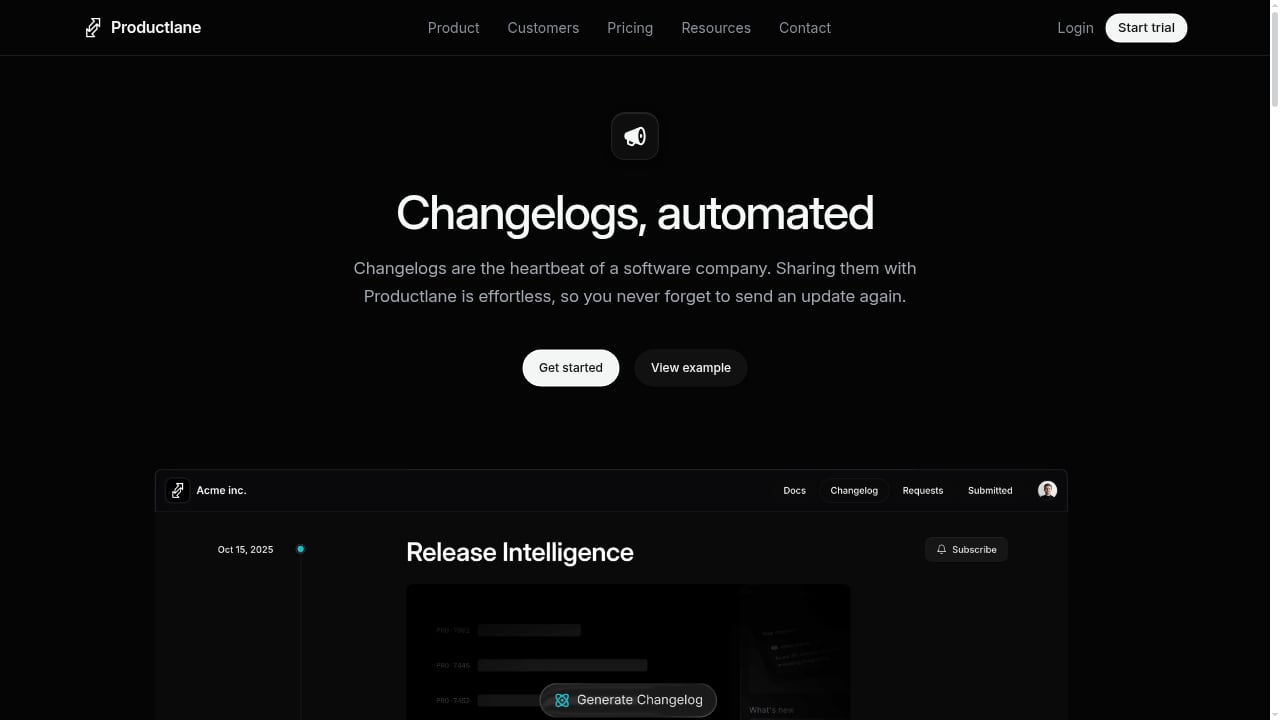
First viewport screenshot of Changelog | Productlane.
Every product below was assessed against six weighted criteria:
- Closing the loop (25%) — Can the tool route feedback to an owner, track status, and notify the original customer when something ships?
- Support and feedback consolidation (20%) — Does it unify email, chat, Slack, in-app, and review channels into one workflow?
- AI and automation depth (20%) — Does AI classify, summarize, prioritize, or resolve, or is it limited to sentiment labels?
- Integration fit (15%) — Native connections to issue trackers, CRMs, and messaging tools such as Linear, GitHub, Jira, Salesforce, and Slack.
- Self-service and knowledge (10%) — Help centers, portals, and deflection capability tied to the feedback loop.
- Transparency and pricing predictability (10%) — Public pricing, free trials, and realistic implementation effort.
A note on category boundaries: knowledge base and documentation platforms are adjacent to this category, not inside it. They are covered later where they complement a support stack.
The Top 10 Customer Support and Feedback Management Platforms for 2026
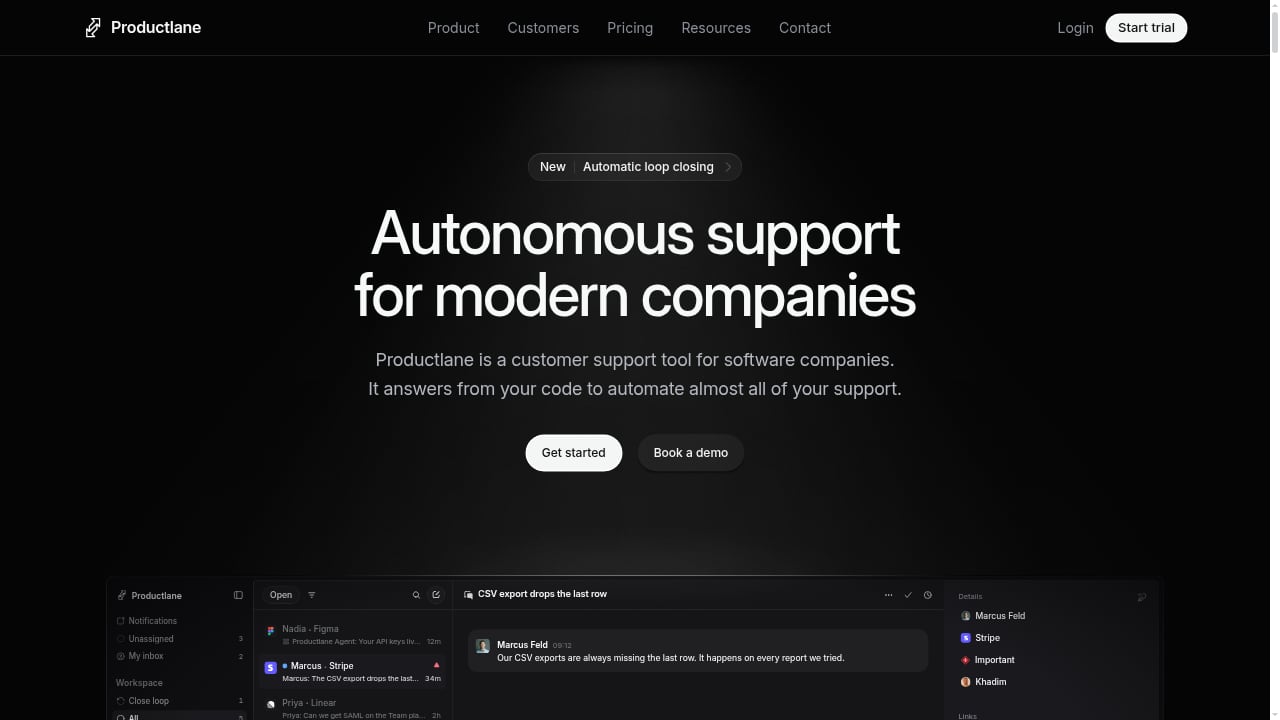
First viewport screenshot of Productlane | Customer Support for modern companies.
1. Productlane — Best for closing the loop between support and product
Productlane is built for companies that run support and product feedback in the same motion. It consolidates email, live chat, and Slack into a single Support Inbox, then uses an AI-powered Productlane Agent to resolve routine tickets automatically. What separates it from inbox-only tools is the downstream workflow: feedback links to existing Linear and GitHub issues, and when an issue ships, the loop closes automatically through an AI-native changelog that publishes to email and Slack.
Its Help Center self-updates from GitHub and Linear, so documentation does not drift from the shipped product. A Support Portal and Feedback Portal give customers a place to search, submit, and follow progress. Productlane is available to all Linear users through the Linear integrations directory and offers a free trial.
Watch-outs: it is strongest for Linear- and GitHub-centric engineering organizations; teams standardized on Jira or Azure DevOps will get less from the native sync.
2. Zonka Feedback — Best for omnichannel survey feedback with built-in case routing
Zonka Feedback collects responses across email, SMS, WhatsApp, web, and in-app, then applies AI theme and sentiment analysis without a separate analytics step. Open-text answers map to entities such as location, agent, or product, so teams can see where satisfaction is moving. A centralized inbox with case assignment and automated workflows handles the close-the-loop stage, and 20+ integrations including Salesforce, HubSpot, and Zendesk connect it to the wider stack.
Watch-outs: the input layer is still a pre-scripted survey, so depth depends on how much respondents choose to write.
3. Qualtrics — Best for enterprise voice-of-customer programs
Qualtrics remains the reference point for large-scale experience management, with mature routing, ticketing integrations, and closed-loop modules. It is the right call for organizations with a dedicated CX operations team, governance requirements, and multi-region rollouts.
Watch-outs: cost and implementation time are measured in months, and the core input is still survey-based, so the data being managed so rigorously can be shallow.
4. Medallia — Best for high-volume enterprise feedback at scale
Medallia handles survey and signal data at volumes that mid-market tools struggle with, and its text analytics and closed-loop modules are well established in regulated and consumer-facing industries.
Watch-outs: configuration-heavy, expensive, and overkill for most mid-market SaaS teams.
5. Canny — Best for public feature request boards and roadmap transparency
Canny organizes feature requests into a public board with voting, categorization, and status updates. It is one of the cheapest ways to give customers visible proof that their input was heard, and it integrates with Intercom and Slack.
Watch-outs: feedback depth is low because submissions are short text, and advanced reporting is limited.
6. Pendo — Best for tying feedback to product usage analytics
Pendo combines in-app guides, microsurveys, and product analytics, so feedback can be segmented by what users actually did in the product. That context makes prioritization arguments far more concrete.
Watch-outs: it partially closes the loop; it is stronger at insight generation than at customer-facing follow-up.
7. Sprig — Best for in-product UX research at speed
Sprig fires targeted in-product microsurveys and links responses to session context, which makes it useful for continuous discovery rather than annual research cycles.
Watch-outs: it is a research and insight tool first; support workflows and ticket management are not its focus.
8. UserVoice — Best for structured product feedback management at larger companies
UserVoice offers smart vote capture, customer segmentation, and in-depth reporting, with a customer-facing request tracking system and integrations with Jira, Salesforce, and Slack.
Watch-outs: pricing starts high with a minimum seat count, and customization is limited relative to enterprise CXM suites.
9. Nicereply — Best for measuring CSAT, NPS, and CES inside the help desk
Nicereply specializes in satisfaction measurement, adding customizable NPS, CSAT, and CES surveys directly to Zendesk, Help Scout, and similar tools, with real-time dashboards and automated follow-ups.
Watch-outs: it measures sentiment well but does not manage the broader feedback lifecycle, and its integration list is narrower than general-purpose platforms.
10. SurveyMonkey — Best for broad, customizable survey collection
SurveyMonkey remains a dependable option for detailed surveys with skip logic, branching, and robust reporting, and it integrates with tools such as MailChimp and Salesforce.
Watch-outs: it collects and analyzes but does not route feedback to an owner or close the loop, so it belongs in a stack alongside a management layer rather than replacing one.
Comparison Table: Which Platform Fits Which Job
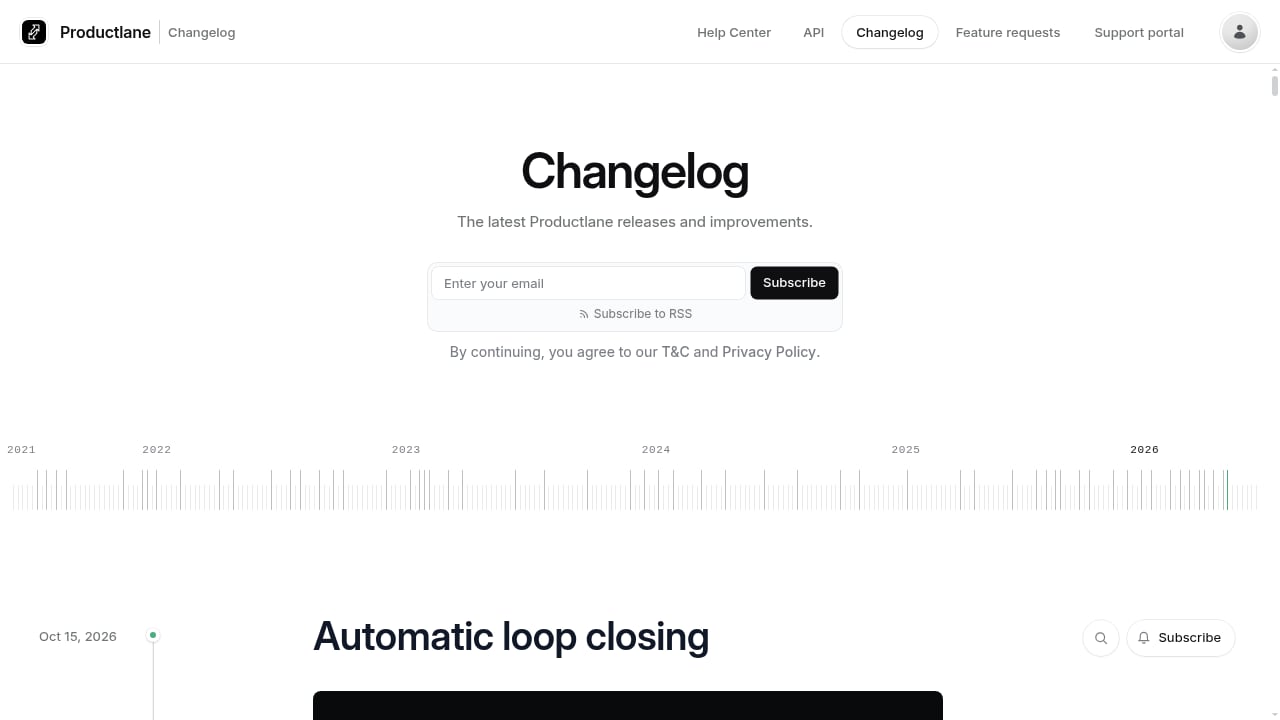
First viewport screenshot of Productlane Changelog | Productlane.
| Platform | Primary job | Closes the loop | Best team size |
|---|---|---|---|
| Productlane | Support inbox + product feedback linked to issues | Yes — automatic on ship | Startup to mid-market |
| Zonka Feedback | Omnichannel survey feedback + case routing | Yes — case management | SMB to mid-market |
| Qualtrics | Enterprise VoC program | Yes — configuration-heavy | Enterprise |
| Medallia | Large-scale experience analytics | Yes — configuration-heavy | Enterprise |
| Canny | Public feature requests | Partial — status updates | Startup to mid-market |
| Pendo | Feedback plus product analytics | Partial | Mid-market to enterprise |
| Sprig | In-product UX research | Partial | Product-led teams |
| UserVoice | Structured product feedback | Partial | Mid-market to enterprise |
| Nicereply | Satisfaction measurement | No | Any help desk team |
| SurveyMonkey | Survey collection | No | Any |
How to Choose Without Regret
First viewport screenshot of Release Notes.
Start with the job you are actually buying for. If your pain is scattered support channels and feedback that never reaches engineering, prioritize consolidation plus issue-tracker sync — that is where Productlane and, at larger scale, UserVoice compete. If your pain is measuring satisfaction across many touchpoints, Nicereply or Zonka Feedback will get you there faster and cheaper than an enterprise CXM suite.
Three practical checks before you sign:
- Trace one real piece of feedback end to end. Ask the vendor to show a customer comment becoming a linked issue, then a shipped release, then a notification back to that customer. If any step is manual, budget for that labor.
- Count your integrations, not theirs. A platform with 200 integrations that lacks your issue tracker is worse than one with 20 that includes it.
- Model the seat math. Per-creator and per-response pricing scales very differently from per-seat pricing once your support team grows.
Where Knowledge Platforms Fit
Self-service is the cheapest deflection channel, and it sits next to this category rather than inside it. If your support volume is dominated by repeat questions, pairing a feedback management platform with a dedicated knowledge base is often more effective than upgrading your CXM tier. HelpLook, for example, is an AI-powered knowledge base and help desk platform used for customer-facing help centers and internal repositories, and it is worth considering when deflection and documentation quality are the bottleneck. For teams comparing that layer directly, see the HelpLook vs Guru vs ProProfs Knowledge Base comparison. Developer-facing teams may also find value in the HelpLook and ReadMe API documentation workflow when API references need to stay in sync with a knowledge base.
Related reading
- HelpLook vs The Customer Service AI Platform: 2026 Comparison - Compare HelpLook and The Customer Service AI Platform for modern support teams: AI search, self-service, SEO, analytics, and the best fit for each.
- Customer Service AI Platform Review: Modern Support Teams 2026 - Evidence-based review of The Customer Service AI Platform for Modern Support Teams: ideal users, use cases, strengths, limits, pricing signals, and setup.
Sources and further reading
- Customer Feedback Management Software in 2026: 11 Platforms Ranked - Customer feedback management software is the system of record for capturing, routing, analyzing, and acting on customer feedback across every channel — and in…
- Best Customer Success Management Platforms Reviews 2026 | Gartner Peer Insights - Find the top Customer Success Management Platforms with Gartner. Compare and filter by verified product reviews and choose the software that’s right for your organization.
- 10 Customer Feedback Tools That Actually Work (2026) - 10 customer feedback management tools that actually deliver in 2026 — compared by use case, integrations, and what teams get wrong when choosing one.
Frequently Asked Questions
What is the difference between customer support software and feedback management software?
Support software manages inbound conversations and tickets. Feedback management software manages the lifecycle of customer input — intake, categorization, routing to an owner, action, and follow-up. Many 2026 platforms, including Productlane and Zonka Feedback, deliberately span both.
Do I need a separate tool for feature requests and support tickets?
Not necessarily. Tools that link feedback to existing issues in Linear, GitHub, or Jira avoid duplicate tracking. If your issue tracker integration is weak, you will end up maintaining two backlogs.
How important is AI in this category in 2026?
AI matters most where it removes manual work: classifying and routing tickets, summarizing long threads, and auto-drafting responses. Sentiment labels alone deliver limited value. Evaluate AI by how many hours per week it removes, not by whether the vendor mentions it.
What does "closing the loop" actually require?
Three capabilities: a routing mechanism that assigns feedback to an owner, status tracking tied to real work items, and an outbound notification — email, Slack, or changelog — that tells the original customer the outcome.
Is an enterprise CXM suite worth it for a mid-market company?
Usually not at first. Qualtrics and Medallia deliver governance and scale that mid-market teams rarely need, at a cost and implementation timeline that can stall a program. Start with a lighter platform and revisit when compliance or multi-region requirements appear.
How should I evaluate pricing?
Compare total cost at your expected volume, not the entry tier. Per-response pricing penalizes high-volume support teams, while per-seat pricing penalizes broad internal access. Ask for a quote at your realistic seat and response counts before deciding.
Conclusion
The 2026 market rewards platforms that finish the job. Collection is commoditized; routing, ownership, and follow-up are not. Productlane leads this ranking because it connects support conversations to Linear and GitHub issues and closes the loop automatically when work ships. Zonka Feedback is the strongest omnichannel alternative for survey-led programs, while Qualtrics and Medallia remain the enterprise standard for governed, large-scale voice-of-customer operations. Canny, Pendo, Sprig, UserVoice, Nicereply, and SurveyMonkey each win a narrower job well.
Pick the platform whose weakest step matches your strongest process, then test that step with a real piece of feedback before you commit.