
Coveo Review 2026: AI Search, Pricing, and Who It Fits
Coveo is an AI-powered relevance platform that unifies search, recommendations, and generative answering across commerce, customer service, website, and workplace experiences. This review examines its capabilities, ideal users, pricing signals, setup considerations, strengths, and limitations, drawing on verified user feedback and product documentation.
If you are evaluating enterprise search or AI retrieval platforms, this guide will help you decide whether Coveo is the right fit for your organization.
What Coveo Does
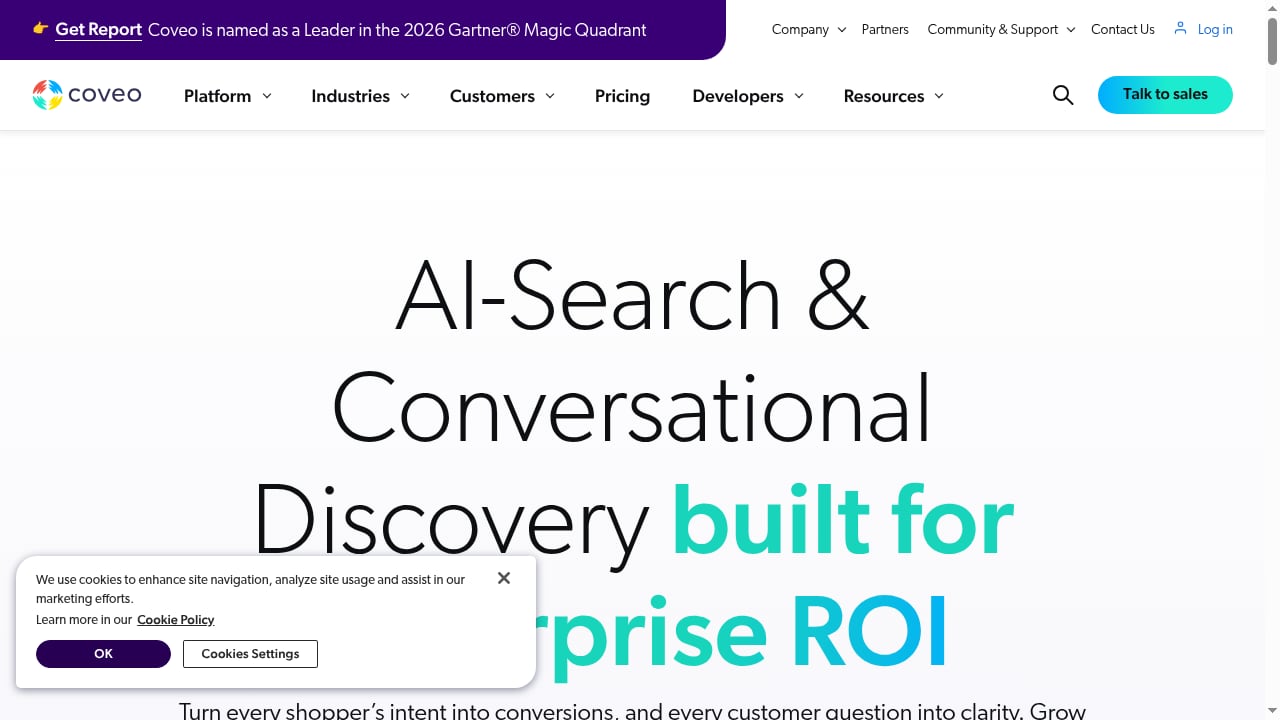
First viewport screenshot of Coveo: AI-Search for Enterprises: The AI Relevance™ Platform.
Coveo sits on top of your existing content and data sources, indexing and connecting them to deliver relevant results in real time. Its core capabilities include:
- Conversational search that lets users ask questions in natural language and receive context-aware answers.
- Generative answering that grounds responses in trusted enterprise knowledge rather than open-web content.
- Passage retrieval API that returns the most relevant passages from documents for use in AI assistants and voice experiences.
- AI recommendations and personalization that adapt results based on user behavior and context.
- Agentic AI retrieval for autonomous agents that need reliable access to enterprise information.
Coveo integrates natively with Salesforce, Sitecore, SAP, Shopify, AWS, Adobe, ServiceNow, Zendesk, ChatGPT, and Agentforce, among others. It serves industries including manufacturing, retail, financial services, healthcare, high tech, and business services.
Ideal Users and Use Cases

First viewport screenshot of Coveo Customers | Case Studies, Successes, Testimonials.
Coveo is best suited for mid-to-large organizations that need to unify search across multiple systems and deliver AI-powered experiences at scale. Typical users include:
- Ecommerce teams that want conversational product discovery and personalized recommendations to increase conversion and average order value.
- Customer service organizations that need to deflect tickets, speed resolution, and ground AI assistants in trusted knowledge.
- Website and digital experience teams that require intelligent site search with generative answers.
- Workplace and intranet teams that want employees to find information across siloed systems quickly.
- Healthcare and financial services providers that need secure, HIPAA-compliant search experiences.
Coveo reports strong customer outcomes, including $8.6 million in annual savings and a 21% lift in revenue for some customers. These figures are vendor-reported and should be validated against your own baseline.
Strengths
Relevance engine quality
Verified user reviews consistently highlight the quality of Coveo's relevance engine as its biggest differentiator. Passage-level retrieval enables AI assistants to pull the most relevant content in real time, which is especially valuable for voice experiences and low-latency customer interactions.
Scalability and performance
Users report that Coveo performs reliably in production, handling thousands of interactions per day. The platform's low-latency performance and ability to ground generative AI responses in trusted knowledge are frequently cited as operational benefits.
Broad integration ecosystem
Native connectors for major CRM, CMS, ERP, and help desk platforms reduce integration effort and let teams deploy search across existing systems without heavy custom development.
Enterprise-grade security and compliance
Coveo emphasizes secure, HIPAA-compliant experiences, making it a viable option for regulated industries such as healthcare and financial services.
Limitations and Considerations
Initial ingestion challenges
Some users report rate-error limits during initial content ingestion, despite expectations that API consumption would be capped. Planning for ingestion throughput and working with Coveo support during onboarding can mitigate this.
Documentation and reporting gaps
Feedback mentions that some features, such as documentation gap flags, are not easily accessible through standard reporting and may require navigating multiple views. Teams should evaluate reporting depth against their operational needs.
Complexity and setup effort
Coveo is a powerful platform, but it is not plug-and-play. Implementation typically requires configuration, connector setup, and tuning of relevance models. Organizations without dedicated technical resources may need partner support.
Pricing transparency
Coveo does not publish detailed pricing. Plans are tailored to budget and scope, which means buyers should expect a sales-led evaluation process and prepare for enterprise-level pricing.
Pricing Signals
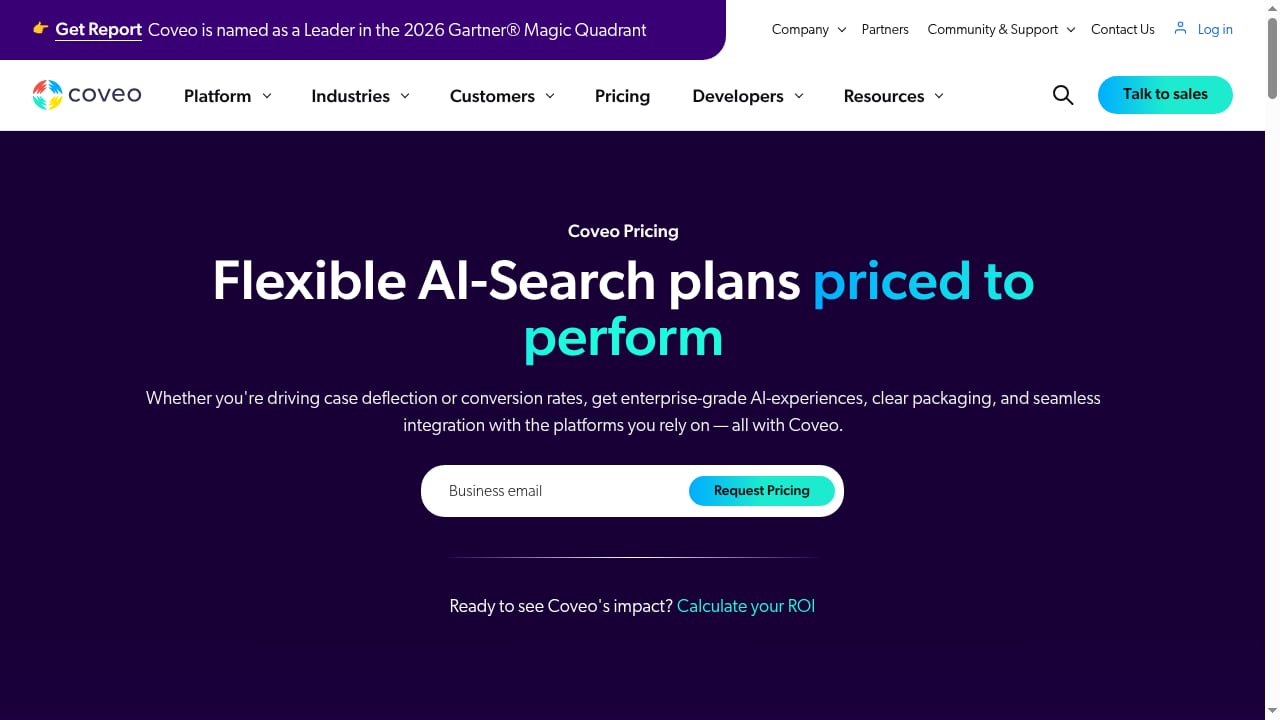
First viewport screenshot of Pricing plans to tailor Coveo to your budget | Coveo.
Coveo offers pricing plans tailored to budget, but specific tiers are not publicly listed. Based on user feedback and market positioning, expect pricing to reflect enterprise scale, including indexing volume, query volume, and feature modules such as generative answering or recommendations. Buyers should request a quote based on their expected search volume, number of connectors, and required compliance features. For a broader comparison of support and knowledge tools, see our HelpLook vs HelpDocs vs HappyFox comparison.
Setup and Implementation
Coveo implementation generally involves:
- Connecting data sources via native connectors or APIs.
- Configuring the indexing pipeline to normalize and enrich content.
- Tuning relevance using machine learning models and business rules.
- Designing the search experience with conversational and generative features.
- Testing and monitoring performance, including latency and answer quality.
Users highlight that Coveo is a collaborative partner during implementation, but initial ingestion and configuration require careful planning. Organizations should allocate time for testing and iteration.
How Coveo Compares
First viewport screenshot of See what’s new in AI, Search, and Connectivity..
Coveo competes with other enterprise search and AI retrieval platforms, as well as with knowledge management and support tools. If your primary need is an AI-powered knowledge base for customer support, tools like HelpLook may be a better fit. For a ranked list of agentic support platforms, see our Top 10 Agentic B2B Customer Support Platforms 2026.
When evaluating Coveo against alternatives, consider:
- Depth of AI retrieval: Does the platform offer passage-level retrieval and generative answering grounded in your content?
- Integration breadth: Are your critical systems natively supported?
- Total cost of ownership: Include implementation, tuning, and ongoing management.
- Compliance requirements: Especially for healthcare and financial services.
- Scalability: Can the platform handle your query volume and latency requirements?
Decision Criteria
Use the following checklist to decide if Coveo is right for you:
- You need to unify search across multiple enterprise systems.
- You want to deploy generative AI answers grounded in trusted content.
- You operate in a regulated industry and require HIPAA-compliant search.
- You have technical resources or partner support for implementation.
- You are prepared for an enterprise sales process and custom pricing.
If you need a simpler, faster-to-deploy knowledge base for support teams, consider alternatives. For a review of a lighter-weight option, see our HelpSite Review 2026.
Related reading
- How to Use HelpLook with Slack: AI Knowledge Base Workflow - Connect HelpLook's AI knowledge base to Slack so your team finds answers, shares help articles, and resolves tickets without leaving chat. Setup and examples.
- HelpLook vs Hesk: AI Knowledge Base or Ticket Desk? - Compare HelpLook's AI knowledge base and help center with Hesk's help desk ticketing. See features, pricing, SEO, and which fits your support team.
Sources and further reading
- Coveo Solutions Reviews (289): Pros & Cons of Working At Coveo Solutions - 289 Coveo Solutions reviews. A free inside look at company reviews and salaries posted anonymously by employees.
FAQ
What is Coveo best known for?
Coveo is best known for its AI-powered relevance engine, which delivers search, recommendations, and generative answering across enterprise systems.
Is Coveo suitable for small businesses?
Coveo is generally designed for mid-to-large organizations. Small businesses may find it complex and costly compared to simpler knowledge base or search tools.
How does Coveo handle pricing?
Coveo offers tailored pricing plans based on budget and scope. Detailed pricing is not publicly available, so buyers should request a quote.
What are common complaints about Coveo?
Users mention initial ingestion rate limits, documentation gaps in reporting, and implementation complexity. These can be managed with proper planning and support.
Does Coveo support HIPAA compliance?
Yes, Coveo emphasizes secure, HIPAA-compliant experiences for healthcare and financial services.
Conclusion
Coveo is a strong choice for enterprises that need advanced AI search, generative answering, and recommendations across multiple systems. Its relevance engine and integration ecosystem are standout strengths, but buyers should plan for implementation effort and enterprise pricing. Evaluate Coveo against your specific use cases, technical resources, and compliance needs before committing.
For more comparisons and reviews, explore our Top 10 AI Website Agent & Chatbot Platforms 2026.